Artificial Grass
Maintenance Manual
Congratulations on the purchase of your new Mazegrass Artificial grass. Your new Artificial grass will require minimal maintenance to keep it looking at optimal level, however we do recommend the following to ensure the longevity of your surface.
- Introduction to maintenance01
- Protecting your lawn02
- Cleaning, grooming and stain removal03
- Watering your lawn06
- Minor repairs06
- Other repairs07
- Key points to remember07
Introduction to maintenance
Following these simple suggestions will significantly extend the life and performance of your product:
- Keep it clean
- Do not abuse it. No vehicle traffic, no heavy static loads, or fireworks, etc.
- Make all minor repairs to your surface promptly
- Consult with a Mazegrass professional if your repairs and renovations are complicated
- Maintain proper infill levels in high use areas
NOTE: This manual is intended for customer use. It is important that the people who are responsible for maintenance are thoroughly familiar with its contents and refer to it regularly. The contents in this manual represent the most current information regarding suggested procedures for the proper use and care of your Mazegrass Artificial grass. All information has been presented in good faith and is believed to be accurate.
Mazegrass makes no representations, warranties or guarantees of any kind, expressed or implied, regarding the information contained herein and disclaims all liability or any loss or damage arising out of its use.
Protecting your lawn
It is good business to protect your investment and take care of your Artificial grass. To do this most effectively, KEEP IT CLEAN. The following maintenance precautions are advised:
- Keep your surface free of litter, mud and debris
- Prohibit smoking and food or drink on the surface
- Repair minor damage promptly
- Follow suggested maintenance and cleaning procedures
Cleaning and stain removal
Rain is the best cleanser. Rainfall gently cleans the fibres of dust, pollen and airborne pollutants in a way that is difficult to duplicate. In areas where rainfall is scarce – or during prolonged periods of drought – an occasional watering is beneficial to cleanse the synthetic surface.
Daily care
Daily care is on-going care; it does not necessarily mean care each and every day. The amount and frequency of daily care is dependant on not only the surface, but also by the volume and the type of use. Mazegrass recommends that every Artificial grass should periodically be blown off to remove litter and dust, etc.
Litter removal
Light trash and airborne dust can be removed easily by hand.
Frequency
The removal of loose rubbish and surface dust should be performed on an as needed basis, generally about once a week depending on usage.
Do’s
It is good business to protect the investment of your Artificial grass. To do this most effectively, keep it clean. Your Mazegrass Artificial grass is designed to resist both wear and exposure to the elements. The effectiveness of their materials, design and construction is demonstrated by the long life under heavy use in many climates. The following are the most obvious precautions:
- Keep the Artificial Grass and close adjacent areas clean and free of litter, mud and debris.
- Prohibit smoking and carrying food or drink onto the grass.
- Repair minor damage promptly.
- Follow suggested maintenance and cleaning procedures.
Contact a Mazegrass representative for assistance with repairs, renovation work, or any further technical details.
Don’ts
DO NOT ABUSE the Artificial grass with:
- Vehicle traffic
- Heavy static loads
- Fireworks
- Storage of materials such as drums, lumber, equipment, etc.
- Open flames, welding, etc.
- Use of wire brushes in any form
- Use of cleaning equipment, materials, and methods not authorized by Mazegrass
- High-pressure water sprays exceeding 500 PSI
- Vehicles with non-pneumatic tires
- Introduction of infills or impregnated layers other than supplied or authorized by Mazegrass.
- Do not allow the use of bikes, skateboards, lawn mowers, etc.
- Do not allow any unauthorized use
- Improper storage of the Artificial grass
Grooming of infilled turf
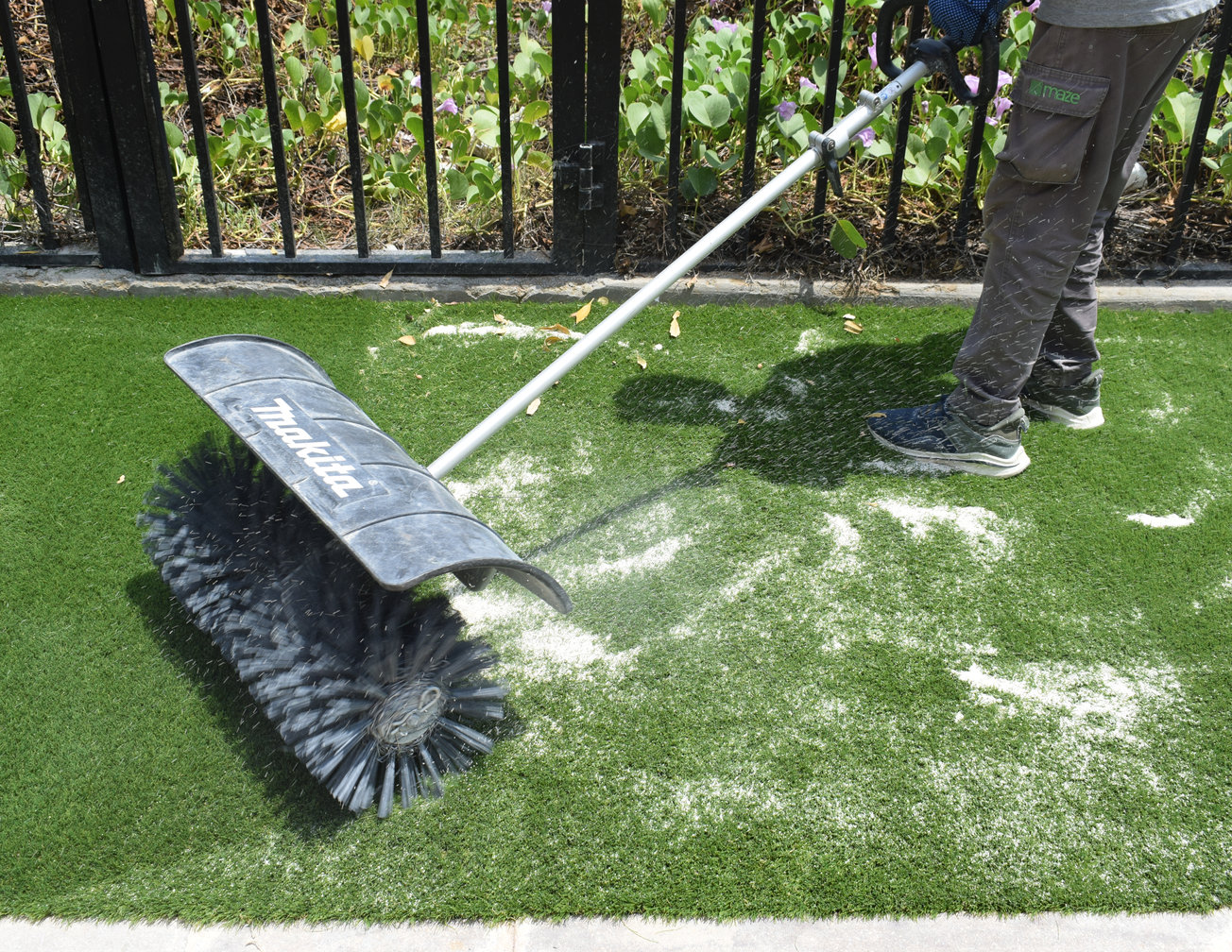
Mazegrass recommends that every Mazegrass Artificial grass has routine brushing every 80 to 120 hours of usage. Routine brushing is accomplished with a Harper broom suitable for brushing the surface. If you do not have a commercial turf brush please contact your Mazegrass representative to purchase one.
Infilled surfaces do require grooming as additional grooming may be necessary only when and if the infill has become displaced due to excessive use in certain areas of the surface.
Weeds & insects
You may notice from time to time weeds growing around the fringe area of your Artificial Grass. You may use any non-coloured weed killer, which can be sprayed directly on the turf to control growth. To avoid ants and insects apply pellets on the affected area and activate as recommended on the label. You can also use any non-coloured pest control agent.
Routine brushing
Routine brushing keeps the surface free from debris, but also keeps your Artificial grass at its optimum performance. Routine brushing simultaneously achieves three objectives:
- Keeps infill layer uniform in its distribution
- Ensures that the exposed part of the fibre is uniform in its direction and stays erect
- Helps remove litter, leaves, dirt, etc.
The realized benefits from routine brushing are:
- Maximum aesthetic appeal
- Lengthened life expectancy
Stain removal general instructions
Mazegrass Artificial grass are among the most stain resistant in the industry. Most stains are not “true” stains but rather residue of foreign matter that must be promptly and thoroughly removed. The first rule in spot removal is promptness. It is always easier to clean up a fresh spill than one that has dried and hardened.
Remove any solid or paste-like deposit with a spatula or table knife. Blot up excess liquids with a thick stack of paper towels or a dry absorbent such as “kitty litter” or Fullers Earth. Dry absorbents can then be swept or vacuumed up.
Mazegrass Artificial grass surfaces provide good resistance to staining. However, it is important to realize they are only one part of a sophisticated system of various components and some cleaning agents that are safe for the fibre can be harmful to other components of the system.
Nylon fibers
Cleaning agents are grouped into two sets, one of which can be used in liberal amounts directly on the turf surface, and the second of which should only be applied by rubbing a cloth soaked in the cleaner, in order to minimize penetration of possibly harmful agents below the turf fibre.
In the first group of cleaners, which generally can be applied to non-infilled systems without any special precautions, are the following:
- A warm, mild solution of granular household detergent in water, or any neutral low sudsing detergent that is recommended for fine fabrics. Use approximately one teaspoon of detergent to one pint of water. This will handle most stains.
- Use three percent solution of ammonia in water for more severe cleaning problems. (NOTE: household ammonia is three percent. Industrial aqua ammonia is 33 percent. Dilute nine parts water to one part industrial ammonia, or the available supply as appropriate.) Thoroughly flush the surface, rinse with plenty of cold water afterwards
- Clean, dry absorbents such as paper towels can be used for applicable stains.
In the second group of cleaners, where agents must be applied sparingly, care must be taken to avoid penetration beneath the turf fibres. We recommend consulting a professional for application instructions.
Polypropylene & polyethylene fibers
Polypropylene & polyethylene fibres are among the most stain resistant fibres known to man. Hence, most “stains” on Artificial Grass polypropylene and polyethylene fields are not true stains but rather residues of foreign matter which must be promptly and thoroughly removed. (This is not the case with nylon and other fibres on the market.)
Most “stains” on polypropylene or polyethylene fields can be removed with water or soap and water. The first rule is promptness. It is much easier to clean up a fresh oil spill before it has time to dry and harden.
Remove any solid or paste-like deposit promptly using a dull knife or spatula-like tool. Blot up excess liquids with a stack of towels, cloth or paper. Dry absorbent clay based materials, such as cat litter absorbers (“kitty litter”) can be very useful and should be stored on site. Such dry absorbers can be swept or vacuumed up.
Cleaning agents are grouped into two sets, one of which can be used in liberal amounts directly on the turf surface, and the second of which should only be applied by rubbing a cloth soaked in the cleaner, in order to minimize penetration of possibly harmful agents below the turf fibres. The first group of cleaners can generally be applied to infilled systems without any special precautions.
“Water borne” residues
Most “stains” commonly associated with polypropylene and polyethylene playing fields can be classified as “water borne” stains. These stains are best removed using a warm mild solution of granular household detergent (non-abrasive) and water.
Typical Water Borne Residues
- Brush the residue with a stiff brush
- Scrub the area with soap and water
- Rinse the area thoroughly with clear water to remove all traces of soap
- Dry with absorbent towel(s), if necessary
A three percent solution of ammonia in water may be used in lieu of household detergent for more stubborn residues or stains.
Non “water borne” residues
In the second group of cleaners, where agents must be applied sparingly, care must be taken to avoid penetration into the turf fibres. We recommend consulting a professional for application instructions.
Typical Non Water Borne Stains
Watering your lawn
Some owners have found it desirable to deliberately wet their lawn, especially in periods of very hot weather. Wetting the surface provides moisture for cooling the surface before evaporation takes place. It also acts as a lubricant to the turf but it must be noted it may also lower traction to a slight degree. On a hot sunny day outdoor playing surfaces can receive enough radiant energy to evaporate about a quart of water per square yard per hour.
As the moisture evaporates the temperature of the synthetic turf will match that of natural grass in the same area. If you decide to water your Artificial grass, be careful to distribute the water evenly. If water is put on the surface, it should not be from a polluted supply. Also be aware, when The Artificial grass is watered on an extremely hot day, you risk dangerously raising the heat index level which can be harmful.
When to repair
To properly maintain your Artificial grass, be aware of day-to-day activities, usage and condition of the facility. It is very important that any minor damage be repaired immediately because a small problem may eventually grow into a major repair. In addition to routine awareness of conditions, once or twice a year, your surface should be given a careful and thorough inspection, preferably in the spring with a follow-up in early fall. All seams should be inspected and any loose areas noted and repaired. Go over the body of each panel of fabric and note any rips and/or tears. Assess the status of the under-padding and the condition of the surface. In the case of an older and/or heavily used surface, inspections should be made more frequently.
What are “minor repairs?”
An open spot in a sewn or glued seam, where the loose area in the seam extends from a few inches to one or two feet (along a glued seam line where at least one of the turf edges is still attached to the seam tape).
Cuts, rips or tears in the surface fabric that are less than six inches or so in length do not generally require a special trip by our service staff and can be repaired by the owner without much effort. These can also be regarded as minor unless allowed to become larger. All of these problems can be handled by sewing or adhering the repairs. To repair minor seam openings or loose seam areas:
- For infilled systems vacuum sand or rubber from the turf to be repaired.
- Be sure that the fabrics to be adhered are dry, free from loose sand, dirt, old adhesive and other foreign matter.
- Remove the area of debris.
- Position the fabric to check for satisfactory final placement.
- Be sure the seaming tape to which the fabric will be adhered is itself adhered to the underlying pad (If system uses an underlying pad).
- Apply a small amount of caulk onto seaming tape. Avoid excessive adhesive to reduce the possibility of bleed through or bleed out. Spread the adhesive with a trowel and trowel so that the entire fabric is coated lightly and evenly.
- Press the fabric into the adhesive bed uniformly.
- Weigh down the area and allow to cure for a minimum of 2 hours.
- For in-filled systems, spread appropriate rubber or sand on the repaired area and brush into the turf thoroughly until even with surrounding playing areas.
Other repairs
Cigarette / firework burns
Use a hand held metal brush (such as is used to remove paint) and brush the spot vigorously to separate the fibres. If brushing the turf does not remove the damage, take a razor knife and cut the fused area away.
Smoking should be strictly prohibited in this area!
Prohibited activities on artificial grass:
- Storage of materials such as drums, lumber, equipment, etc
- Unnecessary vehicle traffic
- Open flame, fireworks, welding, etc.
- Use of wire brushes in any form
- Use of cleaning equipment, methods or materials not authorized
- High-pressure water sprays exceeding 1000 psi
- Vehicles with non-pneumatic tires
- Introduction of infills that varies from Mazegrass specifications
Key points to remember
- Keep the Artificial grass clean.
- Cross-brush the turf surface as often as required.
- No smoking around the Grass. Surfaces do not burn readily, but will scorch as a result of cigarettes and burning matches.
- Do not park vehicles or equipment on the field for hours or overnight.
- Do not abuse the surface by overloading it. Place plywood on surface to protect and to displace weight of heavy loads over a larger area.
- Call for help or advice when you have questions about your Artificial grass and its use. Your representative can assist with your questions and inquiries and we are always eager to help you experience your field to its fullest potential.
- Following the exact recommendations and procedures shown in this manual will assure that your Mazegrass Artificial grass will give you years of good service with minimal maintenance.
Unit 1, 203 Al Quoz Industrial Area 4,
Dubai, U.A.E.
www.mazegrass.com
Artificial Grass Maintenance Manual