Artificial Grass Abu Dhabi: A Practical Guide
How artificial grass is properly installed in Abu Dhabi, what the heat, salt air and sand do to it, and the questions worth asking any supplier.
By Maze Grass
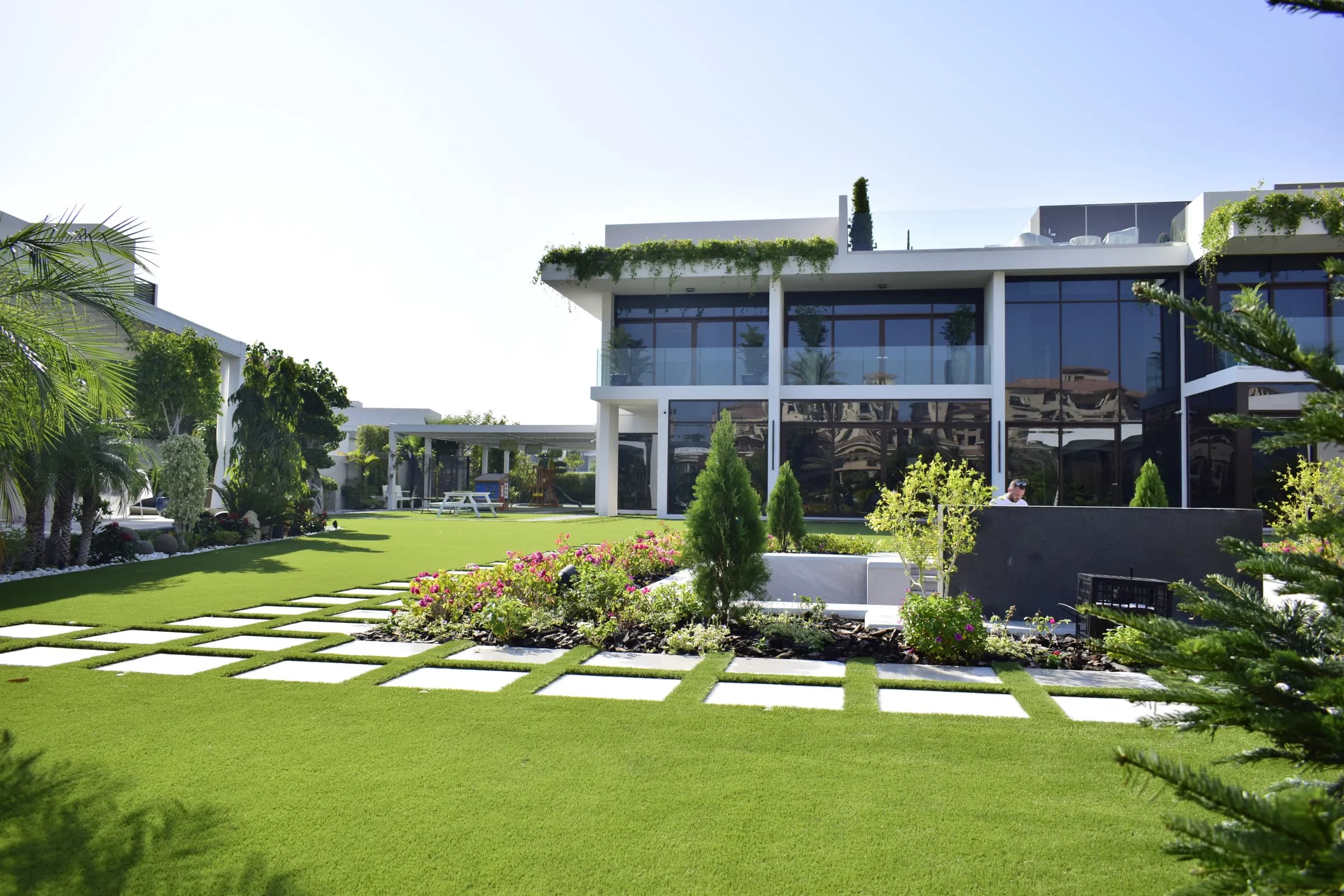
Most of our Abu Dhabi jobs start the same way. Someone has spent two summers watering real grass, watched the garden go patchy by August, and decided they'd rather have something that just stays green. Search artificial grass Abu Dhabi and you'll get a page of nearly identical supplier sites all shouting about 40% off, which tells you almost nothing about what you're buying.
The product that works in the capital is the same product that works in Dubai, and so is the process — the same ground preparation, the same edging, the same infill. What changes is who will actually turn up and do it. Plenty of companies will sell you grass for an Abu Dhabi garden. Far fewer install in both emirates. We do, and we've completed more than 4,500 projects across the UAE to date.
Artificial grass performs well in Abu Dhabi, and the grass itself is no different from what we install in Dubai. What separates a garden that still looks right in year eight from one that ruts in year two is the base underneath it. Insist on a compacted base and a cement gluing edge, and allow three to seven days for a villa garden.
What an Abu Dhabi garden puts artificial grass through
There are three of them, and they're worth understanding before you start comparing products.
Heat. Summer highs in the capital sit in the mid-forties for months, and the National Center of Meteorology records the pattern every year. Every outdoor surface gets hot — stone, decking, composite, grass. High quality artificial grass with UV resistance doesn't fade or go brittle in it, but between June and August it will be too hot to walk on barefoot in the middle of the day. Shade is what changes that — a garden shaded in the afternoon cools down quickly and is comfortable again long before evening. Thirty seconds with a hose drops the surface temperature straight away, and a lighter green holds slightly less heat than a deep one. Anyone who tells you their product stays cool in August is selling you something.
Salt air. Abu Dhabi is built across islands, and a lot of the villas we work on are within a few hundred metres of water. Salt doesn't touch the fibres. It does eat cheap metal fixings, so we use the same edge detail near the corniche that we'd use anywhere — a cement gluing edge rather than pinned timber that rusts out and lifts a seam three years later.
Sand. Fine sand blows in and settles into the pile. That's a maintenance question rather than a durability one, and a brush sorts it. It does mean drainage matters more here than people expect: a base that's silted up will hold water after a wash-down, and that's when you get soft spots.
What we found on a 1,100 m² garden on Saadiyat Island
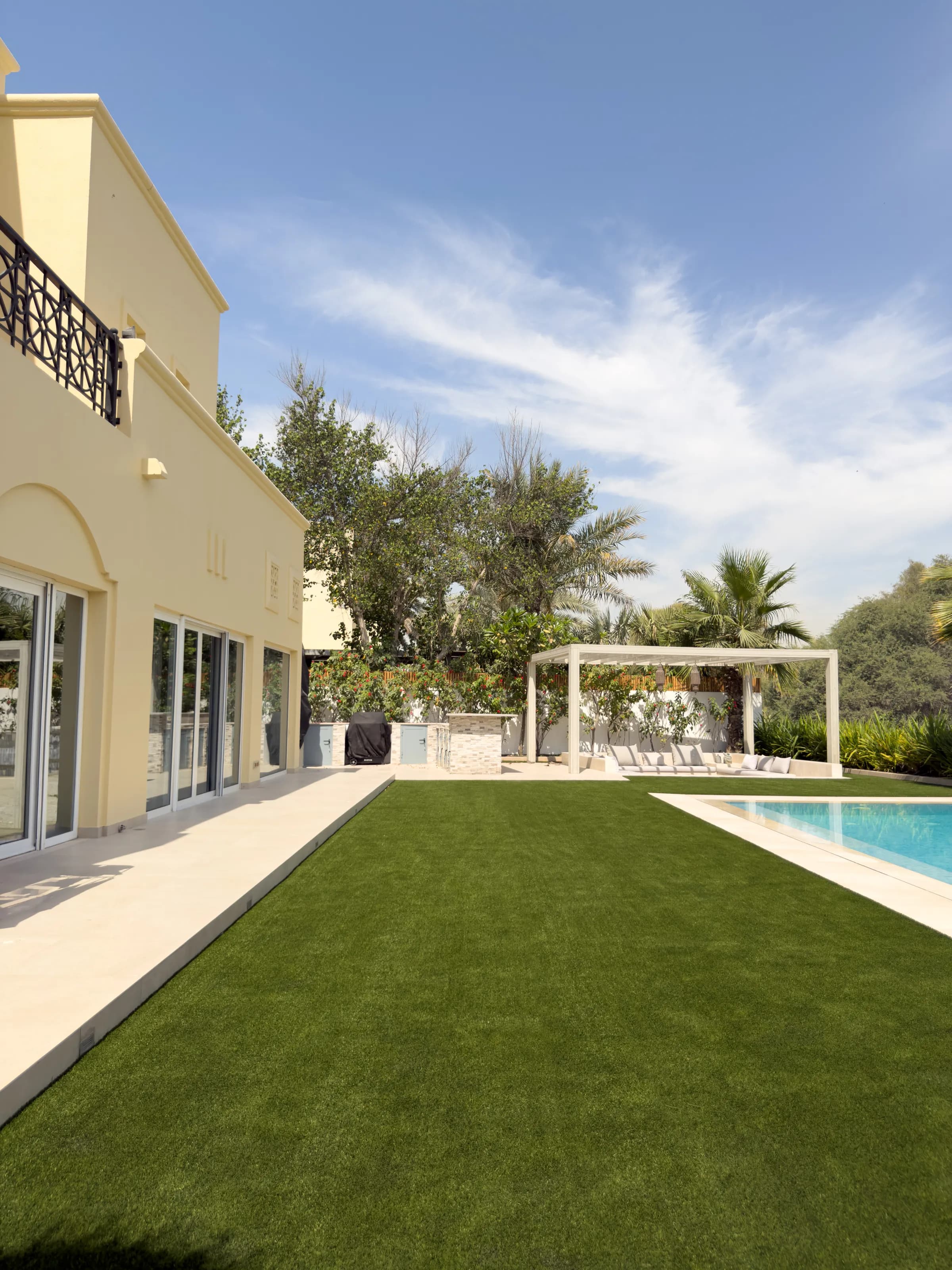
The largest Abu Dhabi project our team at Maze Grass has documented is a villa on Saadiyat Island — 1,100 square metres of integrated garden with mature trees, planted beds and tiling already laid out around the grass area. We used Naples 42 mm, our deepest pile, and it took seven days.
The sequence is worth spelling out, because it's the part most installers skip:
- Full ground preparation. A full black sand base, 7 to 10 cm deep, levelled and compacted. This is the layer that decides whether you get ruts later, and it's the step there's no fixing afterwards.
- A cement gluing edge installed around the perimeter to complete the preparation, so the grass has something solid to bond to.
- Grass laid, trimmed, joined and glued to that edge, with seams set away from the main sight lines.
- Silica sand infill at 4 to 5 kg per square metre, then brushed up so the pile stands.
That's seven days for 1,100 square metres, with the planting and hard landscaping already in place. If someone tells you two days on a garden that size, they're skipping the preparation or the infill, and you'll see it within a year. You can look at the finished garden and the rest of our work on the project case studies page.
What decides how your garden gets built
Three things change the build, and none of them can be judged from a photograph: access (a garden you can only reach through the house is a different job), edging (a cement gluing edge is more work than butting up to an existing kerb) and drainage (a flat site needs channels). That is why we measure on site before anything is agreed.
Delivery is 1 to 3 days on stock and 2 to 3 on large orders, with the full terms published on our delivery information page.
Which pile height suits which space
Pile height is the decision people agonise over and it's simpler than it looks. A deeper pile looks lusher and feels softer underfoot. A shorter pile recovers faster under traffic and is easier to keep clean.
| Product | Pile | Best for |
|---|---|---|
| Duramax 33 mm | 33 mm | Pets, children, high footfall, rented villas |
| Sienna 35 mm | 35 mm | All-round residential and commercial, high traffic |
| Milan 35 mm | 35 mm | The best seller — dense thatch, family gardens |
| Naples 42 mm | 42 mm | Show gardens and villa gardens where the grass is the feature |
Every Maze Grass product carries a minimum 10-year manufacturer's warranty. We can offer that across the whole range because we set the specification ourselves rather than buying containers on price, so we know how every grass type was built.
We'd always recommend asking for a physical sample before you decide. You can see and feel the difference between the grass types properly when they're in your hand, and a screen won't show you either the true colour or how a 35 mm compares to a 42 mm underfoot. We'll bring samples with us to your site visit, or you're welcome to come and see the full range at the showroom.
Four questions to ask before you buy artificial grass
These four sort a serious supplier from a reseller faster than anything else, and they apply whether you're buying in Abu Dhabi, Dubai or anywhere else.
1. Where is the grass manufactured?
Regulation on what goes into the yarn varies enormously between countries. A lot of the cheap grass in this market is manufactured in China, where the rules governing chemical use are not as strict and far less of the process is documented. That's a difference in regulatory regimes rather than a comment on any one factory, but it leaves you with no way of knowing what's in the product. That matters because this is a surface your children sit on and your dog lies on all afternoon — the wrong chemistry means skin irritation at best.
We import all our own grass from Europe, where chemical regulation in manufacturing is strict and enforced. We also have it independently tested by SGS, one of the largest third-party inspection and certification companies in the world. Those tests cover chemical breakdown, heavy metals, UV stability and fire rating. It's a large part of why our products sell as well as they do here, and we'll show you the certificates if you ask.
2. How long has the supplier been in business?
Your warranty is only worth as much as the company standing behind it. Artificial grass suppliers start up and fold in this market every year, and very few last beyond three. A ten-year warranty from a company that won't see out year four is a piece of paper.
Most of the names you'll come across are resellers, buying the same containers from the same factories as everybody else, which is why so much of the grass on offer here looks and performs alike. We import our own from Europe and we've been trading for almost 14 years.
3. Is the grass UV resistant and UV stabilised?
In the UAE this is the single biggest factor in how long your garden lasts. Grass that isn't properly UV stabilised breaks down under the sun here — the fibres go brittle, the colour drains out of them, and the surface disintegrates far sooner than anyone expects. It's not a slow fade over a decade. It can be a couple of seasons.
Ask for the UV test certificates. Not a claim on a website or a line in a brochure — the actual documentation showing the product has been tested and is suitable for this climate. Any supplier importing properly will have them to hand.
4. Is the grass safe for children and pets?
This comes back to question one, and the answer should never be somebody's word for it. Safe means tested and documented: free of harmful chemicals, free of heavy metals, with certificates to prove both. If a supplier can't produce them, they either don't know what's in their grass or they'd rather you didn't.
And three things to check about whoever installs it
The questions above are about the grass. These are about the people laying it, and in Abu Dhabi they matter just as much.
- Where is the stock held? If the answer is "we order it in", then a two-day delivery becomes a four-week wait as soon as your grass isn't already in the country. Ours sits in our warehouse in Dubai Industrial City, which is at the Abu Dhabi end of Dubai.
- Who does the installing? Ask whether the installation team is in-house or subcontracted. Subcontracted teams are where the base build quietly gets cut, because nobody on site owns the result.
- What is the base specification, in writing? You want compacted aggregate or black sand, a defined edge detail, and silica infill named on the specification with the rate per square metre stated. If it just says "supply and install artificial grass", you have no idea what you're getting.
There's no Abu Dhabi branch on our side and we won't pretend otherwise — we're a Dubai company that works across the emirates. The showroom where you handle samples is in Al Quoz, and we're rated 4.9 on Google. If you'd rather not make the drive, we'll bring samples to you on the site visit.
The mistakes we get called in to fix
Laying straight onto sand. No compaction, no edge. It looks perfect on handover day and ruts along the walking line within a season.
Nailing or pinning it down instead of gluing it. This one also looks perfect on handover day. Grass that's only nailed or pinned at the perimeter shrinks back a little with each change of season, and it never quite returns. A year or two on you get gaps opening up along the edges where the grass meets your tiles or paving — a finger's width at first, then wider. Nothing short of lifting and refitting will close them again.
Glued grass doesn't do this. Bonded to a cement gluing edge, the perimeter is held permanently and the seasonal movement has nowhere to go. It's why we install a cement gluing edge on every job, and it's the main reason our installations still look tight along the paving years later.
No cement gluing edge at all. Without something solid to bond to, the perimeter lifts. Once an edge lifts, sand gets under the backing and the whole panel starts to move.
Skipping the infill, or under-filling it. Silica sand does three jobs at once, and none of them are optional here. It weighs the grass down and holds the pile standing upright. It absorbs heat, so the surface runs cooler underfoot than it otherwise would. And it stops static electricity building up in the fibres, which is what gives you that small shock off a synthetic surface in dry air.
The rate is 4 to 5 kg per square metre. It's a real quantity of material and real labour to spread and brush in, which is exactly why it's the first thing cut from a cheap quotation. Ask what rate is being used, and get it written down. Grass with no infill goes flat and stays flat.
Buying on pile height alone. Pile height is only half the story. The other half is the stitch rate per square metre, which is what's known as grass blade density. A shorter grass with a high stitch rate carries more grass per square metre than a longer grass with a low stitch rate. It looks more lush, and it gives you more of a cushion underfoot.
So a well-stitched 33 mm can be the better garden than a sparse 42 mm, even though the 42 mm sounds like more grass on paper. Grass blade density is the number to ask about, and the only way to judge it for yourself is to get a sample in your hand and press your fingers into it.
How the job usually runs
For a typical Abu Dhabi villa garden, expect this shape:
- Site visit and measure. This is when the base specification gets decided. Photographs are not enough — levels and access have to be seen.
- Written specification. Area, product, base build, edge detail and infill. All of it on one page.
- Delivery. 1 to 3 days from our Dubai Industrial City stock, longer on a large order.
- Installation. One to three days for most residential gardens. Bigger integrated gardens like Saadiyat run to a week.
- Handover. Brushed up, offcuts removed, and you can walk on it immediately.
FAQs
Do you install in Abu Dhabi, or only deliver?
Both, and this is the part that separates us from most of the names you'll find. Plenty of companies will sell you grass for an Abu Dhabi garden and leave the installation to you. Our own teams travel down from Dubai and install right across the emirate — Saadiyat, Yas, Al Reem, Khalifa City, Al Raha and the mainland compounds. We've completed more than 4,500 projects across the UAE, and we've been trading almost 14 years. We also supply Abu Dhabi landscapers and pool contractors on trade terms.
How long does our grass last in Abu Dhabi?
At least 10 years. Every grass we sell carries a minimum 10-year manufacturer's warranty. What shortens the life of artificial grass here is almost always poor UV stabilisation. The fibres go brittle within a year or two and disintegrate under foot, so the grass looks short and the backing shows through. A base that was never compacted is a different fault: it deforms the surface, not the grass.
Where is your grass made, and can you prove it's safe?
We import all our own grass from Europe, where chemical regulation in manufacturing is strict and enforced — we're not buying containers of unknown product like most resellers here. Every range is independently tested by SGS, covering chemical breakdown, heavy metals, UV stability and fire rating. If you've got children or a dog on the garden, ask us for the certificates and we'll send them. Any supplier who can't do the same is worth a second thought.
Does your grass get too hot to walk on in summer?
Between June and August, yes it is — and we'd rather tell you that straight than pretend otherwise. So is your stone, your decking and every other surface exposed to the extreme heat of the summer sun. What makes the difference is shade: if your garden is shaded in the afternoon it cools down quickly, and it's comfortable again well before evening. A hose drops the temperature in seconds if you want it sooner. Two things help on our own installations — the grass is UV resistant, so it won't go brittle or fade in that heat, and the silica infill we lay at 4 to 5 kg per square metre absorbs heat and keeps the surface cooler than it would otherwise run.
Can I install your grass myself?
On a balcony or a small terrace over existing tiles, yes, and we're happy to supply the grass on its own. On a garden we'd talk you out of it. The parts that decide whether it still looks right in year five are the compaction and the cement gluing edge, and both need equipment and practice. If you've already got a competent landscaper, we'll supply and talk them through our build.
What's the fastest way to find out what my garden needs?
Book the site visit. Levels, access and drainage decide how the garden has to be built, and none of them can be judged from a photograph. Get in touch and we'll come out to you in Abu Dhabi, measure up and bring the samples with us.