Playground with Artificial Grass: A UAE Safety Guide
What makes a playground with artificial grass genuinely safe in the UAE — shock pads, hygiene, heat and drainage, from the team that installs them.
By Maze Grass
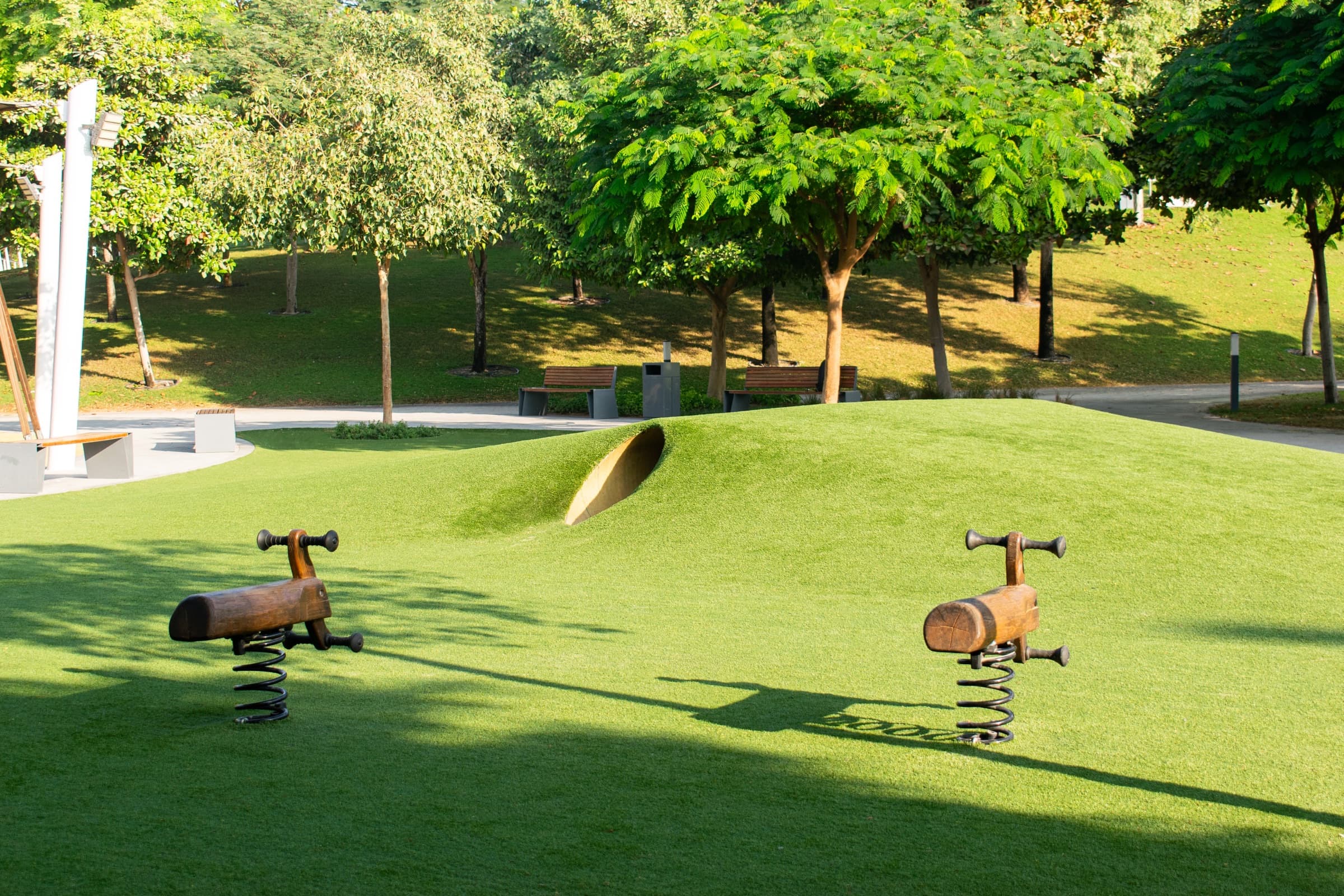
There is large demand for artificial grass for playgrounds and play areas across the UAE. It runs from private villas, where parents have set aside a corner of the garden for their children, through to nurseries and schools. Those school and nursery projects fall under high footfall, and footfall is the thing that should decide which grass you buy.
Different use cases need different grass types. A high-footfall area needs a stiffer grass with thicker blades. That blade stays upright under constant use, it does not flatten as much underfoot, and it holds its appearance for far longer — our Duramax 33 mm is built for exactly that. If the traffic is lighter, a family garden that gets used at weekends rather than all day, you can install a softer grass with finer blades like the Milan 35 mm and get a more natural feel underfoot. Choosing the wrong one is why a play area can look tired long before the grass is anywhere near worn out.
Blade choice is only half of it, though. Under climbing equipment, what matters most is what sits underneath the grass.
Artificial grass makes an excellent children's play surface, but the grass itself does not provide fall protection. Under climbing equipment you need a shock pad beneath the grass, and everywhere else you need a properly compacted base, a glued perimeter and silica infill at 4 to 5 kg per square metre. Get the layers underneath right and the grass on top will look after itself.
What actually makes a play surface safe
There are four separate questions hiding inside the word "safe", and they get muddled together constantly. It's worth pulling them apart, because a supplier can answer one convincingly and quietly ignore the other three.
Impact. If a child falls from height, what absorbs the energy? This is about what sits under the grass, not the grass.
Chemistry. What is the surface actually made of, and what transfers onto hands and knees over a whole afternoon?
Hygiene. Play areas collect spills, food, sun cream and the occasional accident. What happens to all of that in forty-five degrees?
Stability. Does the surface stay flat, or does it develop ruts, lifted edges and trip hazards after a year of use?
An ordinary garden only really has to answer the last one. Your play area has to answer all four, and that's the whole difference between the two jobs. If you're a nursery or a school, add a fifth: you'll need the answers on paper, because an inspection is a documentation exercise as much as a visual one.
The shock pad does the fall protection, not the grass
This is the most important thing on the page, so we'll say it plainly. Artificial grass on its own is not an impact-absorbing safety surface. A 35 mm pile with sand in it feels soft when you press it with your hand, and it will take the sting out of a toddler tripping over at ground level, but it does nothing meaningful for a fall off the top of a climbing frame.
What does the work is a shock pad — a closed-cell foam or rubber layer installed between the compacted base and the grass. Our team at Maze Grass specifies it from your equipment, not from the grass you've chosen. We use the same principle on sports pitches, where it's the layer you feel most in year three, and it's described further on our football grass systems page.
Critical fall height is the useful term to walk into a conversation with. It's the drop height a surface has been tested to protect against, and it's how the European standard for playground surfacing, EN 1177, expresses the result. The pad gets specified from the equipment, so a 1.2 metre platform and a 2.5 metre one need different thicknesses. RoSPA publishes general guidance on playground surfacing that's worth reading if you're speccing a nursery or a school yard.
Two practical consequences follow. If you have a climbing frame, a slide or a swing, ask any supplier what pad thickness they're proposing and what fall height it's rated to — a blank look there tells you plenty about the rest of the job. If you have no equipment at all, and it's simply a flat run of garden where small children kick a ball and ride a scooter, you don't need a pad and nobody should be selling you one.
How a playground with artificial grass compares
| Surface | Fall protection | Hygiene | Summer heat | Upkeep |
|---|---|---|---|---|
| Artificial grass with shock pad | Rated to a fall height, if specified properly | Rinses down, drains through | Hot at midday, cools fast in shade | Brush and rinse |
| Artificial grass, no pad | Ground-level knocks only | Same | Same | Brush and rinse |
| Rubber wet-pour or tiles | Rated, and the usual school choice | Easy to wash, shows every scuff | Runs very hot in direct sun | Patch repairs where it lifts |
| Sand | Good, while it stays deep and loose | The weak point — it collects everything | Cooler, but it gets everywhere | Constant raking and topping up |
| Natural grass | Poor once it thins out | Turns to mud, then to bare soil | Cooler, when it's alive | Daily water, and it still fails by August |
Nothing on that list is perfect. Sand absorbs impact well and it's miserable to maintain here. Rubber is the standard school answer and it gets extremely hot. Artificial grass over a pad gives you the impact figure with a surface that rinses clean and looks like a garden rather than a compound, which is why more nurseries keep asking us for it.
Hygiene where children sit, crawl and eat
Children put the surface in their mouths. That isn't a delicate way to put it, but it's the reality of a nursery play area, and it changes what matters.
Because there's no soil under a properly built play area, there's nothing to turn to mud and nothing living in it. Spills sit on the surface and rinse away rather than soaking into a root zone. A mild detergent and a hose deals with almost everything you'll meet, and our full routine is on the artificial grass care page.
Two product choices make a real difference in this setting. Our antimicrobial grass has the defence woven into the blade and the backing at manufacture rather than sprayed on afterwards, so it doesn't wash out, and it destroys 99% of bacteria on contact. Envirofill infill is acrylic-coated quartz sand carrying Microban, and it gives a 99% reduction in odour while resisting the compaction that makes a heavily used surface pack down hard.
Neither is compulsory. If your play area is a corner of a family garden, ordinary silica infill is fine and always has been. If you're running a nursery with fifty children on it every day, the upgrade earns its place.
Heat, and what actually helps
Here's the honest answer rather than the marketing one. From June through August, artificial grass in full midday sun is too hot to walk on barefoot. So is your paving, your decking and your rubber safety surfacing. Anyone who tells you their product stays cool through a Dubai August is selling you something.
What changes the picture is shade, and it's worth planning the play area around it. A space shaded through the afternoon cools down quickly and is comfortable well before evening. Thirty seconds with a hose drops the surface temperature straight away. The silica infill absorbs heat and keeps the surface cooler than it would otherwise run, and a lighter green holds slightly less heat than a deep one.
There's also Stay Cool yarn, which reflects solar energy and runs up to 15°C cooler than conventional artificial grass in comparable conditions. The technology is extruded into the fibre rather than applied as a coating, so it can't wear off. It won't make your surface cold in August, because nothing does, but on a school yard with no shade structure 15°C is the difference between usable at four o'clock and not.
A shade sail over the equipment is still the highest-value thing you can add to a UAE play area, whatever the surface underneath.
Drainage, and why a play area is different
A garden gets washed down occasionally. A play area gets washed down often, and that raises the stakes on drainage.
Everything drains through the backing perforations and into the base. If your base was properly prepared, the water disappears and the surface is dry within minutes. If it wasn't, water sits in the layer under the grass, and that's when you get soft spots, smells and a surface that never quite dries between washes.
On a hard substrate — a tiled courtyard, a concrete yard, a roof terrace — the water has to reach an existing drain rather than soak away, and we cover that groundwork in our post on laying artificial grass over concrete, tiles and decking.
How the build differs from an ordinary garden
The sequence is the same one Maze Grass uses on every job. What changes is what gets added, and where the tolerances tighten.
- Full ground preparation. A full black sand base, 7 to 10 cm deep, levelled and compacted. On a play area the levelling matters more than usual, because a dip that would be invisible in a garden becomes a trip point where children run.
- A cement gluing edge installed around the perimeter to complete the preparation, giving the grass something solid to bond to.
- Shock pad, if there's equipment to fall from. This is the extra layer, and it's specified from the equipment height.
- Grass laid, trimmed, joined and glued to that edge, with seams routed away from the busiest running lines rather than straight across them.
- Silica sand infill at 4 to 5 kg per square metre, brushed up so the pile stands.
The silica does three jobs at once and all three matter more here. It holds the pile standing upright under constant traffic. It absorbs heat, so the surface runs cooler underfoot. And it stops static electricity building up in the fibres, which is what gives children that small shock off a synthetic surface in dry air.
One more difference deserves its own paragraph. The grass is glued to the cement edge, never nailed or pinned. Grass held down only by pins shrinks back a little with each change of season and never quite returns, so within a year or two gaps open along the edges where the grass meets the paving. In a garden that's ugly. In a play area it's a toe-catcher, and nothing short of lifting and refitting will close it.
Which grass suits a play area
Pile height is the decision people agonise over, and it's the wrong one to lead with. Ask for the stitch rate per square metre too, known in the trade as grass blade density. It's a measure of how thick the grass is. A shorter grass with a high stitch rate carries more grass per square metre than a longer grass with a low stitch rate, so it looks more lush and gives more cushion underfoot. A well-stitched 33 mm can look fuller than a sparse 42 mm, even though 42 sounds like more grass.
For play areas we'd normally point you at the shorter, denser end of the range. Duramax 33 mm is the most durable and resilient of the four, and it's what we'd suggest for hard use and high footfall. Sienna 35 mm balances durability with a natural look. Milan 35 mm is the best seller and has an ultra-dense thatch, which makes it the usual choice where your play area sits inside a family garden that also has to look good. Naples 42 mm is the deepest and lushest, and it's a show garden grass rather than a nursery one. All four are on the product range page.
We'd always recommend getting a physical sample in your hand before you decide. Press your fingers into it, because that's the only way you'll judge density for yourself, and a screen won't show you the true colour either.
The mistakes we get called in to fix
Grass laid straight onto sand. No compaction, no edge. It looks perfect on handover day and ruts along the running lines within a season.
A climbing frame over grass with no pad. The most common serious mistake in a domestic garden, and it usually happens because nobody asked the question.
Infill skipped or under-filled. Spreading and brushing in silica at 4 to 5 kg per square metre is real material and real labour, which is why it's the first thing cut from a cheap job. Grass with no infill goes flat, stays flat, and loses the little cushion it had. Ask what rate is being used, and get it written into the specification.
Seams run through the busiest line. A joint straight across the route between the slide and the gate takes ten times the traffic of one set at the edge. Seam placement is a planning decision, not something to sort out on the day.
FAQs
Can you prove your grass is safe for children?
Yes, and we'd want a parent or a nursery manager to ask every supplier they speak to exactly this. We import all our own grass from Europe, where chemical regulation in manufacturing is strict and enforced, rather than buying containers of unknown product the way most resellers here do. Every range is independently tested by SGS, one of the largest third-party inspection and certification companies in the world, covering chemical breakdown, heavy metals, UV stability and fire rating. Ask us for the certificates and we'll send them.
Does your grass protect a child falling off a climbing frame?
Not on its own, and we'd rather tell you that than sell you something on a false claim. Fall protection comes from a shock pad installed between the compacted base and the grass, specified from the height of your equipment. We build that layer in when it's needed and leave it out when it isn't, and either way it appears on your written specification so you can see exactly what you're getting.
How long will a nursery play area last before it needs replacing?
At least 10 years, and every grass we sell carries a minimum 10-year manufacturer's warranty. What shortens the life of artificial grass here is almost always poor UV stabilisation. The fibres go brittle within a year or two and disintegrate under foot, so the grass looks short and the backing shows through. A badly built base is a separate risk on a play area: it deforms the surface into dips children trip on.
Can I lay it myself in the back garden?
On a small terrace over existing tiles, yes, and we're happy to supply the grass on its own from our stock in Dubai Industrial City. On a ground-level play area we'd talk you out of it. The compaction and the cement gluing edge decide whether the surface is still flat and gap-free in year five, and both need equipment and practice. If there's equipment to fall from, the pad specification isn't a guess worth making yourself.
What's the fastest way to get a play area specified properly?
Book the site visit. Levels, access, drainage and the height of your equipment decide how the area has to be built, and none of those can be judged from a photograph. Our own teams install across both Dubai and Abu Dhabi, which is more than most suppliers in this market will do — plenty will sell into the capital and leave the fitting to you. Get in touch and we'll come out, measure up and bring samples with us.