Does Artificial Grass Get Hot in Dubai?
Does artificial grass get hot in Dubai? An honest answer from our experience over a 14 year period — what cools it down, and what doesn't.
By Maze Grass
Does artificial grass get hot? It's the question we get asked more than any other, and it's usually asked with a bit of suspicion, because whoever's asking has already had three suppliers tell them their grass stays cool. It doesn't stay cool. Nothing in the UAE stays cool between the months of July and August. When a customer asks, this is our response.
Yes, artificial grass gets hot. From June through August it's too hot to walk on barefoot in the middle of the day — and so is your stone, your tile and your decking. Shade is what changes it. A garden that's shaded in the afternoon cools down quickly and is comfortable well before evening, and thirty seconds with a hose drops the surface temperature straight away.
That's the honest answer. The rest of this is the detail behind it: why it heats up, how it stacks up against the surfaces you've already got, what genuinely brings the temperature down, and what doesn't work no matter who's telling you it does.
Why does artificial grass get hot in the first place?
Living grass has one advantage that no synthetic surface can copy. It draws water up through its roots and lets it go through its leaves, and that evaporation carries the heat away with it. It's the same reason you feel cold when you climb out of a swimming pool. Real grass in full sun sits close to air temperature because it's giving up water all day long, which is also why it drinks so much of it here.
Artificial grass has no water to give up. The fibres are polyethylene. They sit in the sun, they soak up the energy and they hold onto it. There's no evaporation and no root system, so nothing is carrying that heat away. The surface climbs above air temperature and it stays there until something changes — cloud, shade, a hose, or sundown.
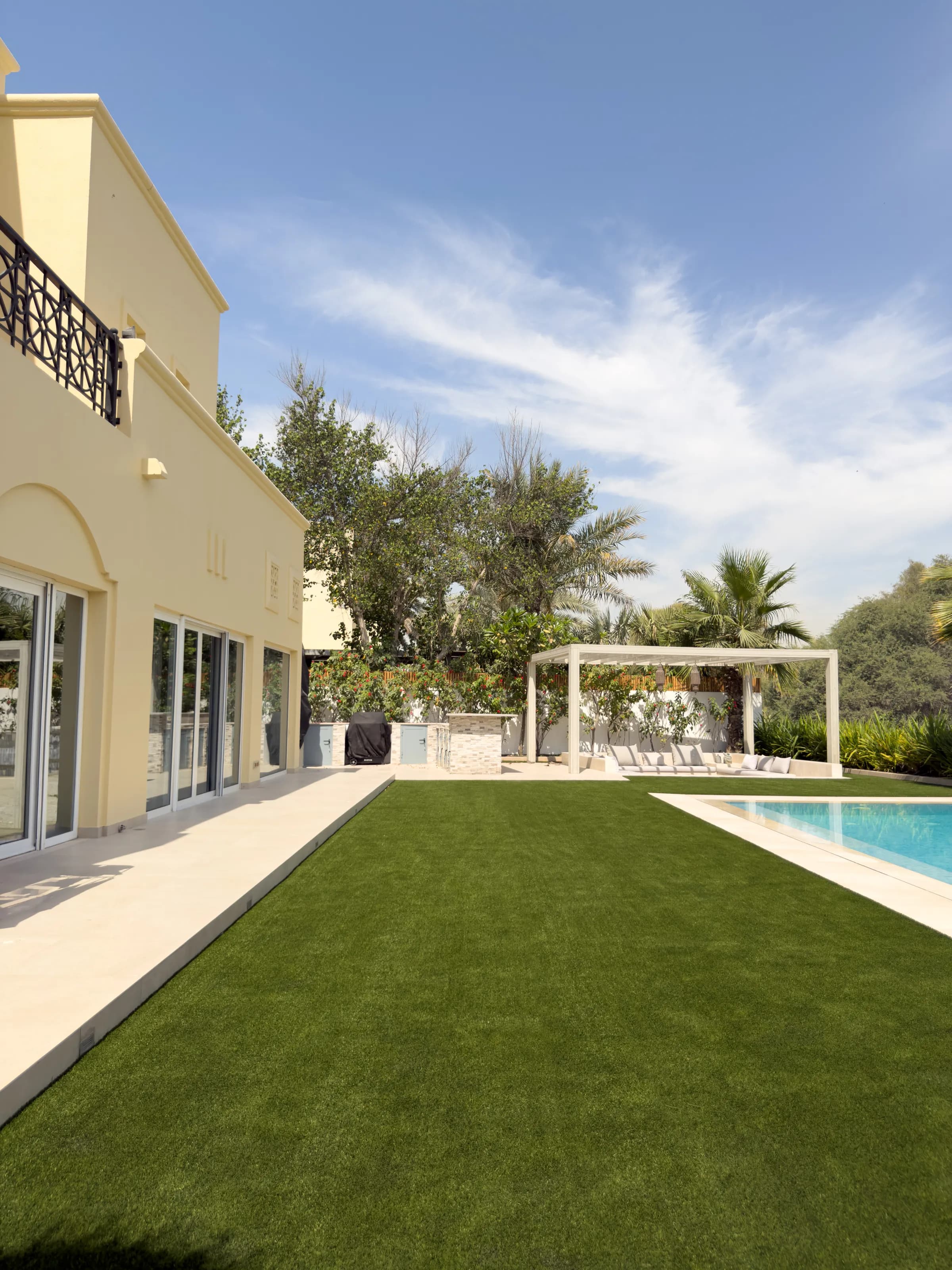
There's a second thing going on that people rarely think about, and it's the reason two gardens in the same community can feel completely different in August. The grass isn't only taking the sun that falls on it directly. It's also taking whatever gets bounced onto it by everything around it — glazing, white boundary walls, light paving and glass pool fencing. In a villa garden that's enclosed on three sides by pale walls and full-height windows, the surface is being hit from several directions at once, and it runs hotter than the same grass laid in an open, planted garden a street away.
That's the whole mechanism, and everything else in this post follows from it.
How hot is it really — and why won't we give you a number?
We're not going to give you a number, and we'd be careful of any supplier who does.
Surface temperature depends on the hour, the month, the colour of the fibre, whether there's a breeze, how much infill is sitting in the pile and what's underneath it. A figure taken from a test in another country in another month tells you nothing at all about your garden in Al Barsha in August. If someone quotes you a temperature, ask them where it was measured and when. You won't usually get an answer.
What we can tell you is how it feels, because our installers are working in gardens like yours right through the summer.
From roughly November through April it's comfortable — barefoot, all day, no thought required. Through May, and again in September and October, the middle of the day is warm underfoot and everything either side of it is fine. From June to the end of August, in direct midday sun, you'll want shoes on, exactly as you would on paving or on a pool deck. The National Center of Meteorology puts the highs in the mid-forties across those months, and every surface in your garden is responding to that.
The part people don't expect is how fast it turns around. Artificial grass has very little mass compared with a slab of stone. It heats up quickly and it gives that heat straight back up again, so a garden that falls into shade mid-afternoon is usable long before the sun has gone down.
How does it compare with the surfaces you've already got?
This is usually where the conversation turns, because people weigh artificial grass against an imaginary cool alternative rather than against what's actually in their garden right now.
| Surface | In direct midday sun, June to August | How quickly it recovers in shade |
|---|---|---|
| Artificial grass | Too hot for bare feet | Fast — low mass, sheds heat quickly |
| Stone and porcelain paving | Too hot for bare feet | Slow — holds heat well into the evening |
| Composite or timber decking | Too hot for bare feet, darker boards worst | Moderate |
| Sand | Too hot for bare feet | Fast at the surface, hot underneath |
| Living grass, well watered | Usually walkable | Stays near air temperature all day |
Living grass really is the cooler surface, and we're not going to pretend otherwise. What it costs you is a daily irrigation habit, a garden that's gone patchy by August anyway, and a water bill you'll notice. We've gone through that trade-off properly in our comparison of artificial and natural grass.
Against every hard surface, though, artificial grass comes out neutral to favourable. Nobody ever complains that their travertine gets hot, because they've already made their peace with it. All the scrutiny lands on the grass, because it looks like something that ought to be cool.
What actually brings the temperature down?
Five things work. We've put them in rough order of how much difference they make.
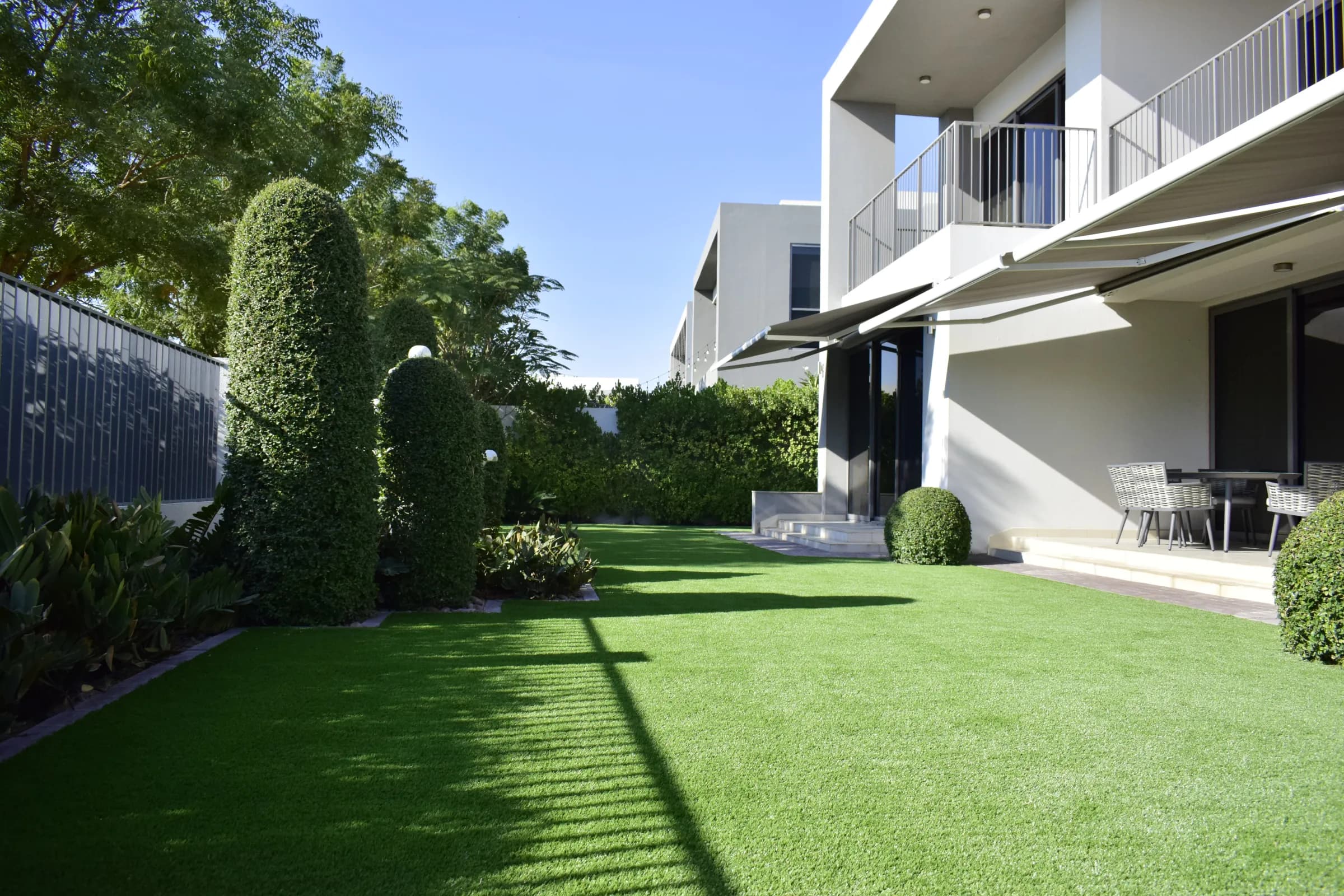
Shade. Nothing else comes close. A pergola, a shade sail, a mature tree or the shadow your villa throws in the afternoon will do more than every product feature ever invented. If you're planning a garden from scratch and you know you'll want to use it in summer, put the seating and the play area where the afternoon shade falls and lay the grass around them. A sail over one corner is a modest bit of work, and it changes how that corner behaves for four months of the year.
Water. A hose over the surface drops the temperature in seconds. It's not permanent, and in August it'll be back up within the hour, but if the kids want to go out at four o'clock a quick rinse is all it takes. It's what most of our customers with dogs do anyway, and it doubles as the routine rinse the grass wants.
Time of day. Early morning and the hour before sunset stay comfortable right through the summer. Most families end up using their garden on that schedule whatever it's surfaced with.
Silica sand infill. The majority of grass suppliers in the UAE leave the silica sand out altogether, because it's real material and real labour and it's the easiest line to quietly drop from a quotation. It shouldn't be optional. Silica sand absorbs a share of the heat, so a garden that's been filled properly runs cooler than the same grass laid over a bare backing.
It also has to go in at the correct quantity. We spread silica sand at 4 to 5 kg per square metre and brush it right down into the pile, and at that rate it's doing three jobs at once — it holds the fibres standing upright, it stops static building up, and it takes some of the heat out of the surface. Too little and you get none of that. Ask for the rate in kilograms per square metre to be written into your specification, and if a supplier won't put a number on it, you've learned something useful.
Fibre colour. A lighter, olive-toned green holds slightly less heat than a deep forest green. The effect is real but it's modest, so treat it as a small bonus rather than a solution. If you're torn between two grasses you like equally and one of them is lighter, take the lighter one.
What doesn't work, whatever you've been told?
Cool fibre technology, as a headline claim. Some yarns are marketed on heat reduction, and one or two of them do measurably reduce surface temperature under test conditions. What they don't do is turn a 45°C afternoon into a barefoot one. If a supplier answers the heat question with a product name instead of a conversation about shade, you're being sold to.
Watering the base instead of the surface. People are sometimes told to soak the ground underneath so it evaporates up through the grass. It doesn't work on a properly built garden, because a good base drains quickly — which is exactly what you want it to do. Rinse the surface instead.
Choosing the palest grass in the room. Chasing a degree or two usually leaves you with a garden that looks artificial, which rather defeats the point. Pick the grass that looks right and solve the heat with shade.
Assuming a shorter pile runs cooler. It doesn't, not reliably. What matters far more is the grass blade density, which is the stitch rate per square metre and a measure of how thick the grass is. A dense 33 mm holds its infill better than a sparse 42 mm, and the infill is the part that's helping you with heat.
What about the kids and the dog?
Most parents who ask us about heat are really asking whether their children can play on it safely in the summer.
For children, it's the same rule you already apply to the pool deck and the car seat buckle. In high summer, midday is for indoors or for shade, and morning and evening are for the garden. A shaded play corner, a rinse before they go out and shoes on at the hottest hour will cover it. That's the routine most families in Dubai are running already, whatever their garden happens to be made of.
Dogs are more straightforward than people expect, and we get asked about them constantly. They find shade on their own, and they won't stand on something that's uncomfortable. What our customers do is hose the grass down before letting them out in the afternoon, and it takes about half a minute. We've written more on that in our guide to artificial grass with dogs and cats.
Around a pool it changes again, because there's water in the equation and wet feet on grass are a non-event. Poolside is one of the places where artificial grass has a clear comfort advantage over the stone sitting next to it, and we've covered the detail in our poolside guide.
Does the heat actually damage the grass?
There's a second question hiding inside the first one. People assume that if the surface is getting that hot, the grass must be degrading. That isn't what happens.
UV is what breaks artificial grass down, not heat, and it's dealt with at the manufacturing stage. Our grass is imported from Europe with UV-stabilised fibres, and it's independently tested by SGS for chemical breakdown, heavy metals, UV stability and fire rating. We'll send you the certificates if you ask for them. Every grass we sell carries a minimum 10-year manufacturer's warranty, and the sun isn't what puts that at risk.
What does cause heat damage is focused heat, and glass is the thing to watch. Reflections off glazing lift the temperature of the grass anyway, as we said above, but certain windows do something more than that. A curved or coated pane can behave like a magnifier, concentrating the sun onto one small patch and pushing the temperature there far beyond anything the rest of the garden sees. In that spot the fibres can melt. A mirror or a glass-topped table can do the same thing on a smaller scale, and so can a barbecue set down on the surface.
We want to be straight about how likely this is, because it gets used as a scare story. It's rare. It needs a specific set of conditions — the right glass, the right curve or coating, the right angle of sun, and enough time on the same patch — and most gardens will never see it in ten years. It's also easy to design around once you know to look. If you've got large or reflective glazing facing your garden, mention it on the site visit and we'll plan the layout around where that reflection actually lands.
Does the way it's installed change how hot it runs?
Two parts of the build make a real difference to temperature, and a cheap job skips both.
The first is the infill, which we've covered above. Grass with no silica in it runs hotter, goes flat faster and builds up static. The second is the base. A proper base of black sand, laid, levelled and compacted, drains and breathes. Grass thrown over a sealed surface with nowhere for air or water to go behaves differently, and you feel it.
That's one of several reasons our team at Maze Grass measures on site rather than working from photographs. What's underneath matters, and levels, access and drainage decide how the garden gets built. You can see how the whole sequence runs on our installation page.
FAQs
Does your grass get too hot to walk on in summer?
Between June and August, in direct midday sun, yes it does, and we'd far rather tell you now than have you find out on handover day. Two things on our own installations make a real difference. The silica infill we lay at 4 to 5 kg per square metre absorbs heat, so the surface runs cooler than the same grass would without it. And because the fibres are UV-stabilised European grass, that heat does them no harm at all — it won't fade or go brittle, which is why it carries a minimum 10-year manufacturer's warranty.
Does the heat shorten how long the grass lasts?
No. Heat is a comfort question; UV stabilisation is the durability one. What shortens grass here is poor UV stabilisation: the fibres go brittle within a year or two and disintegrate under foot, so the grass looks short and the backing shows through. Rutting from a base that was never compacted is a separate fault, and a real one, but it deforms the surface rather than degrading the grass.
Is there a grass in your range that stays cooler than the rest?
There's nothing in our range we'd sell you on the promise of a cool surface in August, and honestly, we'd treat that claim with suspicion from anyone. What we will say is that a lighter tone holds marginally less heat, and that a dense grass holds its infill better, which helps you more. Duramax 33 mm and Milan 35 mm are both densely stitched and both hold silica well. Come to the showroom in Al Quoz and put your hand on them — you'll learn more in five minutes with a sample than you will from any specification sheet.
Can I do anything about the heat on a garden that's already down?
Yes, and shade is nearly all of it. A shade sail over the part of the garden you actually use is straightforward to add, and it transforms that area for four months of the year. After that, check the infill. If the grass has gone flat and the pile won't stand up, it's probably under-filled, and topping it up and brushing it through will help with both problems. Our care and maintenance guide runs through the brushing routine.
What's the best way to plan a garden around the summer heat?
Get someone to look at it. Which corner your villa shades in the afternoon, where the reflective glass is, whether a sail or a pergola makes sense, where the seating ought to go — none of that can be judged from a photograph, and it's the difference between a garden you use in June and one you look at through the window.
Come and see us at the showroom in Al Quoz, have a feel of the samples and ask us whatever you like. Or get in touch and we'll come out, measure up and bring the samples to you. No pressure and no hard sell — just a straight answer about your own garden.