Dragon Mart Artificial Grass
A practical comparison of Dragon Mart artificial grass and Mazegrass, covering quality, installation standards and long term performance in Dubai.
By Maze Grass
Most people who ask us about Dragon Mart artificial grass have never been there. They hear the name from their contractor or their landscape company, the grass for the garden is coming from Dragon Mart, and they want to know whether that's fine.
It's a fair question, and the answer depends on what the grass is going on. Some of what's sold there is perfectly serviceable, some of it isn't, and you can't tell which from the roll. We sell the alternative, so weigh what follows accordingly.
Dragon Mart artificial grass is a reasonable buy for a short-term job — a rental balcony or an event. It's the wrong buy for a garden, because the stitch rate is usually low and the backing is rarely UV resistant, so the grass goes flat within a season and thins out within a year or two, and replacing it falls to whoever installed it.
What Dragon Mart actually is
Dragon Mart in International City is a general trading market, and that shapes the grass sold there. It's very large, and artificial grass comes from a lot of units across it, alongside carpets, flooring and plastic plants. There's far more choice than you'd expect, and that's the problem rather than the solution: the product varies enormously from one unit to the next, and nothing on the floor marks out the good rolls.
Three things follow, whether you go yourself or your contractor goes for you.
Stock changes. It's bought in containers as opportunities come up, not held as a consistent product line. Buy 40 square metres now and need another 10 next year, and matching it is unlikely.
You're buying a roll, not an installation. The person selling it sells carpet and matting too. Questions about ground preparation, joins, edging or infill aren't what the counter is there for, so your install rests on whoever your contractor puts on site.
A quoted specification isn't a verified one. Plenty of the traders will quote general technical specs — pile height, stitch rate, Dtex, material type — and some know their products reasonably well. The problem is what sits behind the numbers. A figure spoken across a counter has nothing independent behind it, and what's almost never available is the documentation: a third-party certificate for UV stability, chemical breakdown and heavy metals. Anybody can quote a Dtex figure. Very few can hand you the certificate that proves it.
None of that makes Dragon Mart a bad place to buy grass. It just means the judging falls to you, or to whoever is buying for you, with no independent paperwork behind it.
Why is the grass so cheap?
Because of what's been taken out of it. There are three savings, and all three show up later.
The first is the grass blade density. That's the trade term for the stitch rate per square metre. A low stitch rate means less grass per square metre, so the pile flattens under foot and doesn't come back up. You'll see it first on the route from the door to the seating area.
The second is the backing. Cheap backings are thin and weakly coated, so tufts work loose and the grass sheds.
The third is UV stabilisation. Even where the grass itself has some UV resistance, the backing has to be UV resistant too. If it isn't, that layer breaks down within a year or two, it can no longer hold the grass, and the grass thins out rapidly from there. You won't see it coming, because the surface looks fine right up until the tufts start letting go.
How to judge a sample
You'll most likely be handed a sample by your contractor, or you'll see the rolls when they arrive on site. Either way, these are the checks we'd make ourselves. Each takes a minute and tells you more than the label does.
- Look down into the pile. Bend the sample back on itself. If you can easily see the backing through the fibres, the stitch rate is low. A shorter grass with a high stitch rate has more grass per square metre than a longer grass with a low stitch rate. It stands up better under use and feels more cushioned underfoot. A well-stitched 33 mm makes a better garden than a sparse 42 mm, even though 42 sounds like more grass on paper.
- Press it. Put your palm flat on the grass, lean on it, then take it away. Good grass springs back in a few seconds. Cheap grass stays flat, and that's what your walkway will look like after one summer.
- Turn a corner over. You want a solid, evenly coated backing, not a thin one that flexes and crackles. Then tug a single blade. If it comes away in your fingers, the tufts aren't locked in.
- Look at the colour, outside. Real grass is never one shade of green. Better products use two or three tones plus a brown thatch layer at the base. Judge it in daylight against your own paving.
- Ask for the sample in the first place. If your contractor can't put a piece of the actual grass he intends to lay into your hand, sort that out before anything is ordered.
What to ask your contractor or landscape company
These are fair questions for anybody supplying grass, us included. Your contractor answers to you, so it's an easier conversation than you'd have across a counter in the market. If he can't answer all four, that's your answer.
Ask where the grass is manufactured. Artificial grass is a plastic product, and where it's made decides what regulation applied while it was made. We import our own grass from Europe, where chemical regulation in manufacturing is strict and documented. The artificial grass sold in Dragon Mart is almost entirely manufactured in China, where the rules governing chemical use in manufacturing are not as strict and far less of the process is documented. That's a difference in regulatory regimes rather than a comment on any one factory, but it leaves you with no real way of knowing what's in the product. Children sit on this surface and pets lie on it for hours.
Ask who honours the warranty, and how long they've been trading. A warranty is only worth as much as the company behind it, and artificial grass suppliers open and close in the UAE every year. Very few last beyond three, so a ten-year promise from a two-year-old company is a piece of paper. Ask too whether that company imports its own grass, because most here buy the same containers from the same factories.
Ask for the UV certificate, and ask what it covers. Most suppliers claim UV resistance on their website. Ask to see third-party test results instead. Then ask whether they also cover the backing.
Ask for the safety testing, not a reassurance. Not "yes, it's safe" — certificates. Our grass is independently tested by SGS, one of the world's largest inspection and certification companies, for chemical breakdown, heavy metals, UV stability and fire rating. We send those certificates to anyone who asks.
The ground underneath is the larger part of the job
Buying the grass is one part of the job. Preparing the ground underneath it is the larger part, and it's what decides whether your garden is still flat in year five.
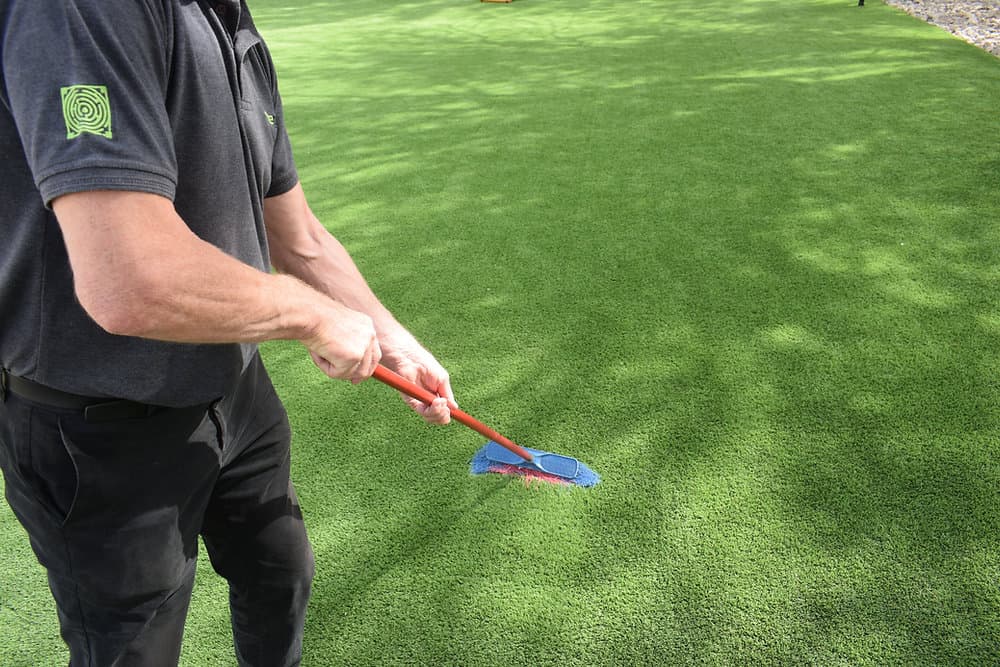
Where the ground is being built up from scratch, that means full ground preparation: a black sand base of 7 to 10 cm, levelled and compacted, with a cement gluing edge installed around the perimeter. We then lay the grass, trim it, join it and glue it to that edge, keeping the seams away from sight lines. Silica sand infill goes in last at 4 to 5 kg per square metre, brushed up through the fibres. The infill does three jobs. It holds the pile standing upright, it absorbs heat so the surface runs cooler underfoot, and it stops static building up in the fibres. It's a real quantity of material and labour, which is why it's the first thing cut from a cheap job. Get that rate written into your specification.
When the install is the problem rather than the grass, it usually fails in one of three ways.
Badly joined seams. A join made without proper seaming tape and adhesive lifts and curls, and it stays curled.
Grass nailed down instead of glued. Grass fixed only with nails or pins shrinks back a little with every change of season, and it never returns. Within a year or two, gaps open along the edges where the grass meets tiles or paving, and they only widen. Nothing short of lifting the grass and refitting it will close them. Glued to a cement gluing edge, your perimeter is held permanently and that seasonal movement has nowhere to go.
Poor base installation. A black sand layer that's too thin, uneven, or never properly compacted will settle under use, and you'll be looking at ridges and hollows across the garden by the second year. You also cannot install artificial grass directly onto sand: the sand subsides over time and the surface becomes uneven. That's why the base is compacted, and why the grass bonds to a cement gluing edge rather than to the ground.
Your contractor can buy the roll in Dragon Mart and lay it, and plenty do. He can buy that way from us too, because we supply grass on its own and charge the installation separately. Either way your recourse is the same. It's his job, so both halves are his to put right: if the groundwork fails he fixes it, and if the grass fails he replaces it and claims the cost back from his supplier. That second half is worth asking him about: a warranty from a trader who won't honour it, or who has stopped trading, leaves him paying for new grass and a second installation. Our breakdown of what goes into an installed garden covers the rest of the job.
So what is the actual difference between us and a trader?
It isn't that we're local. Plenty of the traders selling artificial grass in Dragon Mart are local too, they hold their stock here, and they'll get a roll to site as quickly as we will. Being in Dubai isn't a reason to choose anybody.
The real difference is that we design and import our own grass. We set the specification ourselves — the yarn, the grass blade density, the backing and the UV stabilisation — and we set it for a climate that sits in the mid-forties for months at a time. A trader buying containers from whichever factory quoted best that month has no say in any of that, and usually can't tell you what was specified. Setting the specification ourselves is what makes our product materially better.
This is also the reason we can provide a 10-year manufacturer's warranty on every grass we sell. A company can only guarantee a product for that long if it decided how the product was built.
Dragon Mart and Maze Grass, side by side
| A Dragon Mart trader | Maze Grass | |
|---|---|---|
| Who the grass comes from | A general trader selling carpets, matting and grass | A specialist importer and installer, almost 14 years trading |
| Who set the specification | The factory that quoted best that month | We do — yarn, grass blade density, backing, UV stabilisation |
| Where it's made | Almost always China, where chemical regulation is less strict | Europe, under strict and documented chemical regulation |
| Specifications | Quoted across the counter, nothing behind them | Quoted and backed by third-party test certificates |
| Independent testing | Rarely available | SGS: chemical breakdown, heavy metals, UV stability, fire rating |
| Backing UV resistance | Rarely stated, almost never certified | Specified, and covered by the testing |
| Installation | Not offered — your contractor arranges it | Our own teams, in both Dubai and Abu Dhabi |
| How it's fixed down | Whatever the fitter does, often nails or pins | Glued to a cement gluing edge around the whole perimeter |
| Infill | Usually skipped | Silica sand at 4 to 5 kg per square metre, brushed up |
| Warranty | Usually offered; whoever installed the grass has to pursue the claim | 10-year manufacturer's warranty on every grass we sell |
Is Dragon Mart grass good enough for your garden?
Most people searching for artificial grass Dubai Dragon Mart want to settle one thing: whether the grass is good enough for what it's going on. That depends on what that is.
For a small balcony in a rental you're leaving next year, or a green surface for an event next weekend, it's a sensible choice. Nothing that makes this grass fail in year three matters over that timescale.
Pets are one case where we wouldn't make that compromise, however short the timescale. A dog lies on the surface for hours and chews at it, and undocumented chemical breakdown, no certificate covering the backing and fibres that shed as that backing breaks down aren't things we'd put an animal on.
For a garden you intend to live with, the answer goes the other way. The gap between market grass and properly manufactured grass is real, but it isn't enormous, and it disappears the first time a garden has to be lifted and relaid.
What you're after is the right product, properly installed, backed by a reputable company. For a wider view of your options, we've also written about choosing an artificial grass supplier in Dubai.
If you're buying in the market yourself
Some people do go out to International City and buy direct, and for a balcony or an event that's perfectly reasonable. Run the checks above on the roll itself. Ask for an offcut and look at it outside, because grass reads differently under the market's strip lighting than it does in your garden. Buy the whole quantity in one go, with a margin for cuts.
Common questions about Dragon Mart artificial grass
My contractor is sourcing the grass from Dragon Mart. Should I stop him?
Not automatically. Ask him the four questions above and judge the sample in your hand. If he can show you third-party test results covering the backing, and the grass springs back when you press it, it may well be fine. If he can't produce either, ask him to price the job on grass that comes with the paperwork — ours or anyone else's.
Can Maze install grass bought at Dragon Mart?
We don't, and it isn't snobbery. Our installations carry a guarantee, and we can't guarantee groundwork that carries a product whose construction we're unable to verify. What we'll do is come and look at the space for free, measure it, and talk you through what your ground needs.
How long should artificial grass last in Dubai?
We'd expect at least 10 years from the grass we supply in a domestic Dubai garden, properly installed and covered by the manufacturer's warranty. What shortens that is almost always poor UV stabilisation. Unstabilised fibres go brittle after a year or two and disintegrate under foot, so the grass looks short and over time the backing shows through. That's why the certificate matters, and why it has to cover the backing as well as the yarn. Off a roll in a general market with nothing documented, one to three years is realistic.
If you'd like a second opinion on a sample, bring it in. We'll put it next to ours in daylight and you can judge for yourself, with no hard sell. You can book a free site visit through our contact page, call us on +971 4 288 8651, or find our Al Quoz showroom on the map.