Artificial Grass Ground Preparation in Dubai Explained
Dry fit, semi or full ground preparation? What each type covers, what your existing garden decides, and how to compare two quotations properly.
By Maze Grass
If you have two or three quotations sitting in front of you for the same garden, the wording has probably already confused you. One of them says semi ground preparation. Another says full ground preparation. A third just says supply and install, with nothing underneath it. Artificial grass ground preparation is the part of the job you never see once the grass is down, and it is also the part that decides whether the surface is still flat in year five, so it is worth understanding what each of those lines actually means before you compare anything else.
There are three types of preparation — dry fit, semi and full — and which one your garden needs is decided by what is already on the ground, not by what you want to spend. Two quotations naming different types can both be correct for different gardens. The thing to check is whether the type matches the surface you have, and that the specification says so in writing.
The three types, and what decides which one you get
Every job starts with the same question: what is underneath, and is it sound? The answer sets the type. It is not a menu of good, better and best.
| Type | What it includes | When it applies |
|---|---|---|
| Dry fit | No preparation at all. Installation only. | The base is concrete screed, or a contractor has already prepared the base to our specification. |
| Semi ground preparation | Some material added, compacted, levelled or relevelled. Not a full black sand base. | The garden already has artificial grass over an existing black sand base, or a contractor has installed the base and this requires relevelling and compacting to our specification. |
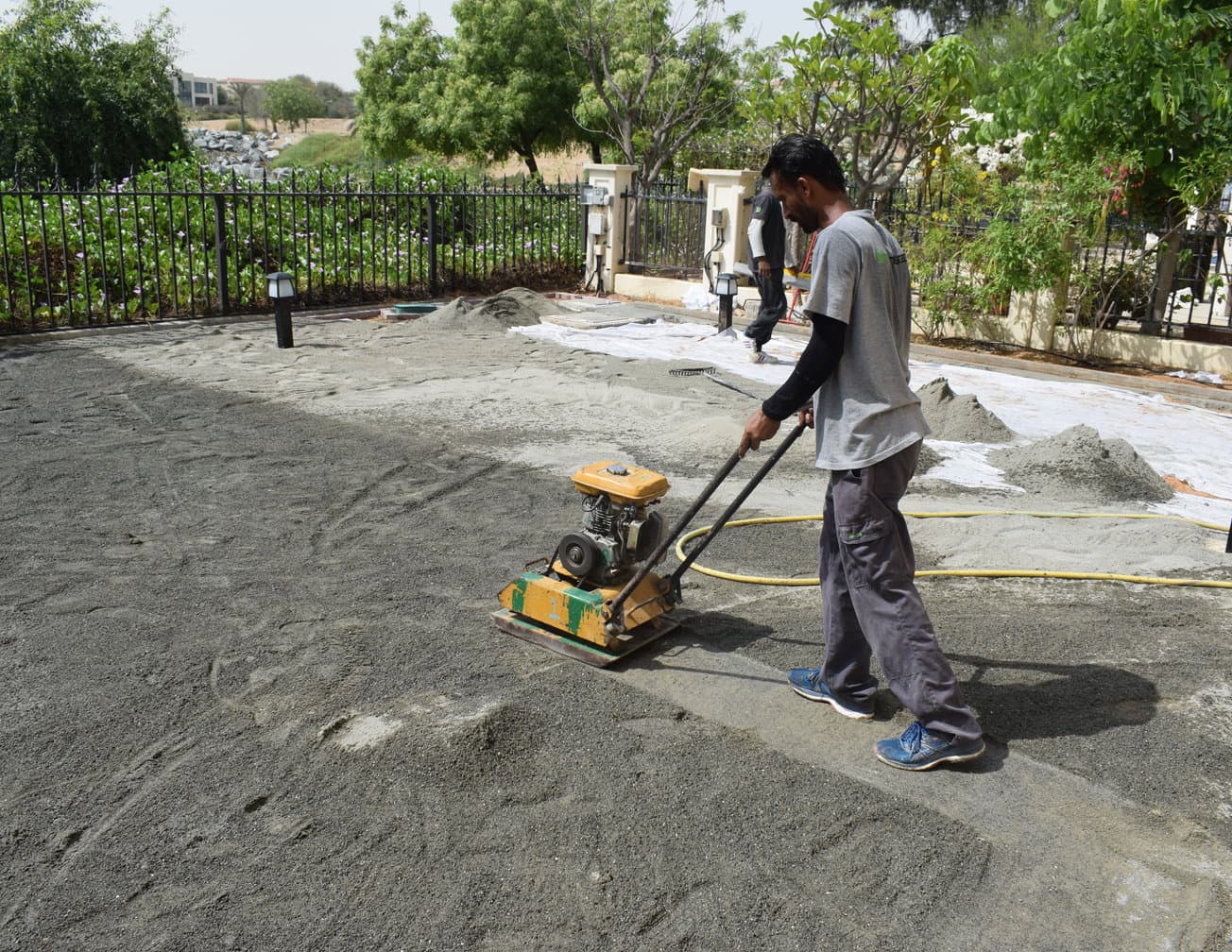
| Full ground preparation | A full black sand base, 7 to 10 cm deep, levelled and compacted, plus the cement gluing edge around the perimeter. | The current surface is natural grass, or the current surface is sand or large gravel. |
Read that table against your own garden rather than against the quotations, and most of the confusion clears up on its own. A villa garden that is currently real grass, or bare sand, needs the full build. A terrace on concrete screed does not — there is nothing to prepare, and charging you to prepare it would be inventing work. Two situations sit in between: existing artificial grass over a sound black sand base, where the old grass comes up and the base is relevelled and recompacted; and a contractor-built base that was never finished to our specification, which requires the same treatment.
Why two quotations can name different types and both be right
If one company has quoted full preparation and another has quoted semi, the instinct is that the second one is cutting corners to undercut the first. Sometimes that is what has happened. Often it is not.
Semi ground preparation is not a partial job or a lesser option. Where a sound base already exists, it is the correct type, and a contractor who quotes it may be entirely right. Laying a fresh 7 to 10 cm base on top of one that is already there and already compacted achieves nothing you would ever see.
So the useful question is not which quotation includes more work. It is whether each one has judged your garden the same way. If two companies disagree about the type, they disagree about the condition of what is underneath, and one of them has looked at it more carefully than the other. Ask each of them directly: what did you find under there, and why does that lead to this type? A supplier who has actually assessed the ground will answer that in a sentence.
This is also the reason we will not specify a type from photographs. Levels, access and drainage have to be seen, which is why the site visit comes before the specification rather than after it.
What full ground preparation actually involves
When the ground is being built up from scratch, the build runs in a fixed order, and every stage in it exists for a reason.
- The black sand base, 7 to 10 cm, levelled and compacted. This is the layer that decides whether you get ruts along the walking line later. Compaction is the part that gets skipped, because it takes time and equipment and nobody can see it afterwards.
- The cement gluing edge, installed around the perimeter. This is what the grass bonds to, and it is part of the preparation rather than a separate extra later on.
- Grass laid, trimmed, joined and glued to that edge.
- Silica sand infill at 4 to 5 kg per square metre, brushed up through the fibres.
Our step-by-step account of how an installation runs covers what happens on site once the preparation is settled.
Ask for an itemised breakdown of the installation
A single line that reads supply and install is not a specification. It is a summary, and it might be covering a full black sand base and a cement gluing edge, or a crew rolling grass out over whatever is already there. You cannot tell from it, and neither can the company you are comparing it against.
So ask every supplier for an itemised breakdown of the installation, item by item, on one page. It takes ten minutes to write and it is the difference between comparing two documents and guessing between them.
- The area, in square metres, measured on site rather than estimated from a drawing.
- The product by name, with the pile height.
- Which type of preparation is allowed for — dry fit, semi or full — and why that type suits your garden. The second half of that answer tells you whether anyone has properly looked at what is under the surface.
- The depth of the black sand base, in centimetres. Full ground preparation is 7 to 10 cm. A document that mentions a base without stating a depth has not specified anything.
- Whether the grass is glued or nailed. Ask it in those words, and treat any answer other than glued as a problem. Grass fixed only with nails or pins shrinks back a little with every change of season and never comes back, so within a year or two gaps open along the edges where the grass meets your tiles or paving, and they only widen. Lifting the grass and refitting it is the only thing that will close them again.
- Whether the cement gluing edge is included, installed around the perimeter. That edge is what the grass is glued to, so the previous answer depends on this one being on the list.
- The silica infill rate, per square metre. It should be 4 to 5 kg, and it should be on the document rather than left to the day.
- How the joins are made, and where they will fall. Seams should be bonded with proper seaming tape and adhesive, and set away from the main sight lines rather than straight down the middle of the garden.
- What is excluded. Waste removal, capping off old irrigation lines, access arrangements — anything you will have to organise yourself.
Two itemised breakdowns can be read line against line, and a thin one gives itself away, because the lines that are missing are the work that was never going to be done. If a supplier will not put the breakdown in writing, we would be cautious about the rest of the job.
Silica sand infill, and why it gets left out
Of everything on that list, the silica infill is the item most easily dropped, and it is the one you cannot check for yourself once the grass is down. Contractors skip it for two reasons. Some have not been taught what the sand is for and treat it as a finishing touch. Others leave it out knowingly, because at 4 to 5 kg per square metre it is a real weight of material to buy and deliver, and working it through the pile is a morning's labour on top. Neither reason shows on handover day, because a garden with no infill looks exactly like a garden with the right amount of it.
The sand is structural rather than decorative, and it does three separate jobs.
It holds the pile standing upright. The weight of it packed around the base of the fibres is what keeps them vertical under foot. Without it the grass lies over along the routes people walk, early and permanently, and brushing will not bring it back.
It absorbs heat, so the surface runs cooler underfoot than it otherwise would. In this climate that is a genuine difference in comfort rather than a technicality.
It stops static electricity building up in the fibres, which is what gives you the small shock people get off a dry synthetic surface.
That makes the infill line worth reading closely on any document you have been sent. A quotation that names a rate in kilograms per square metre was written by somebody who knows what the sand is doing there. One that does not mention infill at all has either left it out or not thought about it, and you want to know which before anything is agreed.
The type of preparation tells you nothing about the grass itself
Preparation and product are two separate decisions, and a quotation can be strong on one and vague on the other. The base decides whether the surface stays flat. The grass decides how long it lasts.
What shortens the life of artificial grass in this climate is poor UV stabilisation. The fibres go brittle after a year or two, they disintegrate under foot, the grass starts to look short, and eventually the backing shows through. The backing has to be UV stabilised as well as the fibres, and plenty of products that claim UV resistance only mean the yarn.
That is a different failure from a badly built base, and the two get mixed up constantly. A base that was never properly compacted deforms the surface — ruts, ridges and hollows across the garden. The grass on top of it can be in perfect condition while the ground under it moves. If someone tells you a rutted garden means bad grass, or that faded brittle fibres mean bad groundwork, they have the wrong diagnosis.
So ask for the third-party test certificates, and ask whether they cover the backing as well as the fibres. We import all our own grass from Europe, where chemical regulation in manufacturing is strict and enforced, and every range is independently tested by SGS for chemical content, heavy metals, UV stability and fire performance. We send those certificates to anyone who asks for them. Every Maze Grass product carries a minimum 10-year manufacturer's warranty with no exceptions, and the warranty terms are published rather than promised. We have been trading for almost 14 years, which matters here, because a ten-year warranty is worth whatever the company behind it is still worth in year eight.
If you are buying the grass and installing it separately
Not every job needs an installed package. We supply grass on its own and charge installation separately, so if you already have a landscaper or a contractor you trust, you can buy the rolls and have your own team lay them.
If you go that way, the type of preparation is still the thing to pin down — it just becomes a conversation with your contractor instead of with us. Ask him for the same itemised breakdown, in writing, before anything is ordered. The work is identical whoever does it; what changes is who carries the result.
FAQs
How do I know whether my garden needs full or semi preparation?
Look at what is there now. Natural grass, bare sand or large gravel means the base has to be built from scratch, so it is full preparation. Existing artificial grass over a sound black sand base usually means semi, and so does a contractor-built base that was not laid to specification. Concrete screed usually means no preparation at all. A site visit confirms it, because a base can look sound from above and still be too thin or unevenly compacted.
Is semi ground preparation a cheaper version of full?
No. The type follows the existing ground. If a proper base is already in place, relevelling and recompacting it is the correct job, and building a second base on top of it would be wasted material. Semi becomes a problem only when it is specified for ground that never had a base to begin with.
Can the ground preparation be done by my own contractor?
Yes, and it happens often. We will give you the specification to work to — base depth, compaction, edge detail — and if a contractor has prepared the ground to that specification, the installation itself is a dry fit. The one thing not to do is let the base be agreed verbally on site, because that is where the depth quietly reduces.
How long does the preparation take?
Most residential gardens run one to three days from start to handover, with the preparation taking up the larger share of that. Bigger integrated gardens take longer. A quotation promising a full base build and an installation in an afternoon is describing something other than a full base build.
If you want to know which type your own garden needs, book a free site visit and we will measure up, check what is under the surface and put the specification in writing.