Installing a Golf Green at Home in Dubai
There is no soil in the UAE, only sand. This is why installing a golf green here requires a different base type.
By Maze Grass
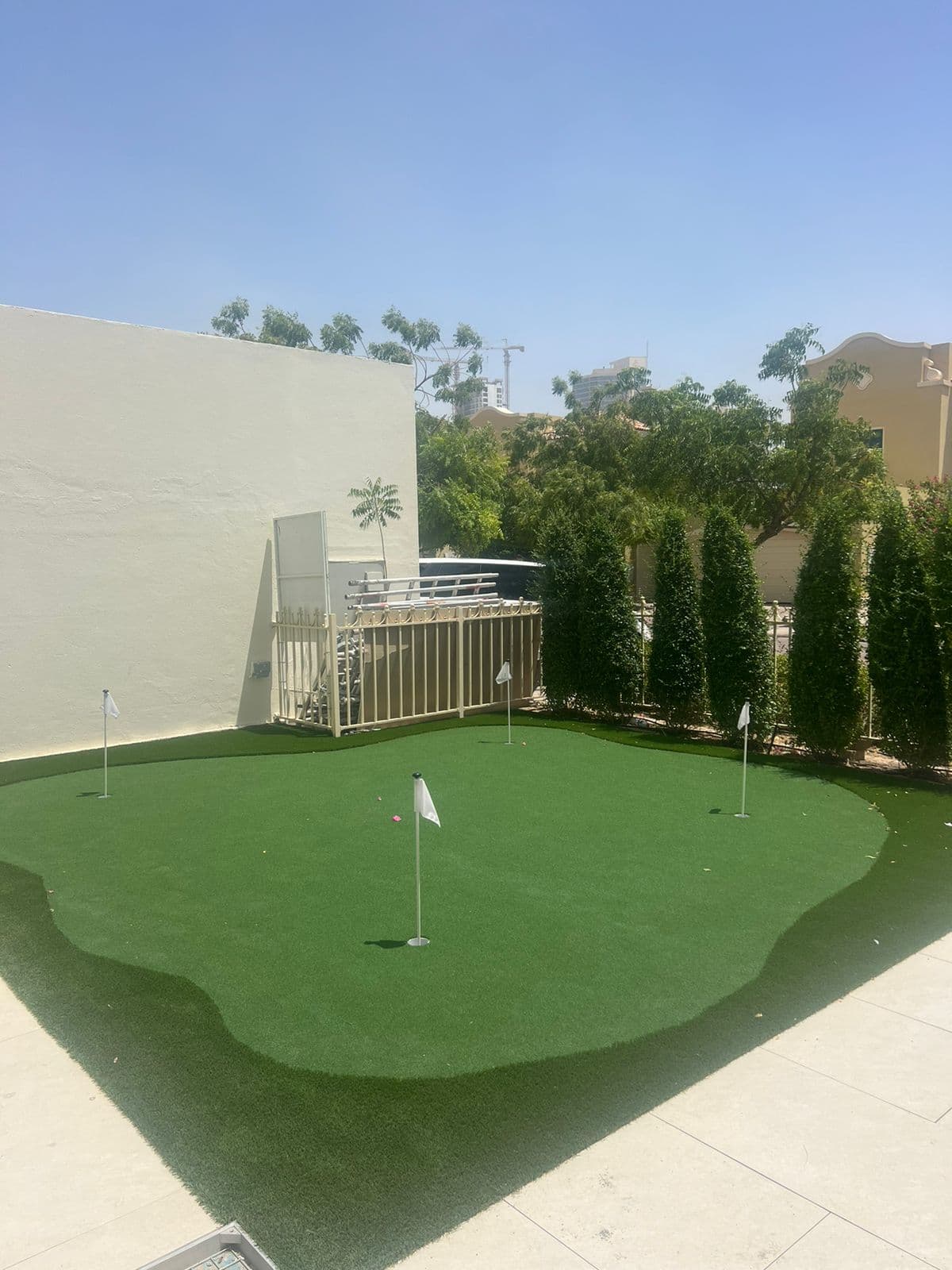
Golf has become more popular since 2020, and interest in a golf green at home has followed. The R&A counted a record 66.6 million golfers across its markets in 2021, up from 61 million, and put the acceleration down to Covid-19, because golf was one of the few sports people could keep playing outdoors at a distance (Record Numbers Now Playing Golf Worldwide, The R&A). That is a global figure, not a UAE one. Far more people enquire about golf putting green installations for their garden than they did five years ago.
If you're thinking about one, there are a number of things you will need to consider beforehand. A putting green will be part of the garden, but there is a different preparation and installation process.
We always recommend building a golf putting green on concrete screed. The ground under any base in the UAE is sand, and gravel or aggregate laid over sand will settle and move, so the green stops matching the design it was built to. Concrete screed holds the shape it was laid to, and it will stand the test of time over the long run. The base and the shaping are the decisions to make first, and the grass goes down at the end.
Why we recommend concrete screed for your golf green
The value of a putting green is how convenient it is. In relation to the installation, it's important that the final build is consistent and the breaks are designed to be subtle.
On a putting green, the roll of the ball shows up any change in the levels.
The ground under any base here is sand, and an aggregate base built over sand does not stay where it was laid. As it moves, the green that was designed for you becomes a different green, and putting that right means lifting the surface and rebuilding what is underneath it.
Concrete screed is a single rigid slab. It holds the shape it was laid to, so the falls stay where they were put. We recommend it because the green will still play the way it was designed years later.
Our golf putting green page has the sizes we build and what each one includes.
How is a putting green different from a garden installation?
In a garden, the type of ground preparation is decided by what is already there, such as sand, existing tiling or natural grass. Our guide to the three types of ground preparation explains what dry fit, semi and full preparation each cover, and any of the three can be the right one for your garden.
For a putting green the base is concrete screed. It has to be designed and laid before the grass is chosen, and once it has cured, the grass installation onto it is a dry fit.
The rest of the method is the same as any other job, and our installation guide sets out how it runs. Groundwork and laying matter equally, and if the screed is shaped wrong the grass cannot correct it.
How much space do you need?
Measure the space before you decide anything else. A three-metre putt needs three metres of putting surface, plus room to stand behind the ball.
We build greens in three sizes.
| Size | Holes | What it gives you |
|---|---|---|
| From 20 m² | 2–3 | A private practice green with putts from several directions. Putting only. |
| From 60 m² | 4–6 | Green plus fringe and a chipping apron, so you can practise short pitches and bump-and-runs. |
| 100 m² and up | 6–9 | A larger shaped green with real breaks, a fringe and an apron. |
More than one cup means you can putt from different places, and you can leave a flag where it is while you work on another. A fringe is the band of slightly longer grass around the putting surface, and it gives you somewhere to chip from and onto. If you have the space for one, we would recommend including it.
How much slope should a golf green have?
If you want breaks in your green, how much slope you can build in depends on how fast the surface rolls.
The USGA Green Section has long guided that the slope across the major part of a putting green should usually not exceed 3 percent, or 1.7 degrees, and that at a green speed of ten feet on the Stimpmeter, any slope of 3 percent or more is too steep to place a hole in at all (Putting Green Speeds, Slopes and "Non-Conforming" Hole Locations, USGA Green Section Record). So the faster the surface rolls, the gentler the slopes have to be.
On a small green you reach that limit quickly. A slope has to level out before the hole, and 20 square metres does not give you much room to do it, so a steep tier there rules out several hole positions.
The slope is shaped into the screed rather than into the grass, so you will need to agree it before the screed is laid. It cannot be adjusted on installation day.
What about rain and the summer heat?
Rain here is rare, and when it does come it comes heavily. Concrete screed is not porous, so water cannot drain through it like a black sand base. The falls have to be designed to take the water somewhere instead. Where the water goes depends on the site, and it is one of the things we look at when we come out to measure.
From June through August the surface will be too hot to walk on barefoot in the middle of the day, and so will your paving, your stone and your decking. A green that falls into shade in the afternoon cools down quickly and is comfortable well before evening, and thirty seconds with a hose drops the surface temperature straight away.
FAQs
How long does an artificial putting green last in the UAE?
At least ten years. The grass carries a manufacturer's warranty, and the term depends on which grass is specified for your green, so ask us to confirm it in writing. Artificial grass here fails early when the fibres were never properly UV stabilised. Those fibres go brittle within a year or two and break up under foot, the grass starts to look short, and in time the backing shows through. Ask for the third-party test certificates, and ask whether they cover the backing as well as the fibres.
Does a putting green need much brushing?
Yes, more often than a garden does, because the roll of the ball shows up a pile that has gone flat. Brushing keeps the fibres standing upright.
Can I build a green on a roof terrace or over existing tiles?
It depends on what is already there. Concrete screed, sound and level, is the right base for a green, so a terrace already laid with screed can be a good candidate. Tiles are a different question, because their falls, joints and flatness were designed for drainage rather than for a ball rolling across them. It needs looking at on site before anyone gives you an answer.
How do I see the grass before I decide?
Ask for a sample pack. The samples come from the manufacturer, they are free of charge, and you can view and collect them at our Al Quoz showroom. We would always recommend taking a pack away and looking at it in daylight in your own garden, because photographs really do not do it justice.
If you're considering a green, book a free site visit and our team at Maze Grass will measure the space, look at the levels and the drainage, and put the specification in writing before anything is agreed.