Artificial Grass Suppliers in the UAE: A Trade Guide
What contractors, developers and facilities teams should ask artificial grass suppliers in the UAE before committing a project to a specification.
By Maze Grass
Buying artificial grass for a client is a different job from buying it for your own garden. The supplier needs to be reliable so that every aspect of the landscaping works is delivered without delay. At some point a client or a consultant is going to ask you for specification or testing data, and if you can't provide it, you're going to run into issues later down the line.
We supply contractors, landscapers, fit-out companies and facilities teams across the UAE, so we hear the same handful of questions before a first order. This is what we'd want to know before placing an order.
The two main questions are whether the grass the client has selected is in stock, and what the lead time is for delivery or installation. Both are important, because either one can slow a project down and impact the handover. Ask for specification sheets and test certificates at the beginning too, so they're on hand if the consultant or the client asks for them.
What separates a trade supplier from a retail one
A retail supplier sells one garden at a time. If a roll is short the customer waits a week, and it doesn't cost anybody very much. On a site, a week late means an installation team standing idle and a handover date moving, and you're the one who has to explain it to the main contractor.
So it's worth asking a few straightforward questions before you commit to anyone. How many sqm of a particular grass type do they have in stock? Will the same person handle your account on the third order?
None of that is in a brochure, but a fifteen minute phone call will tell you. Make the call before you price the work rather than after you've won it.
Is the grass currently in stock?
Ask this one first, because the answer affects your dates more than anything else on the quotation.
Our stock sits in our warehouse in Dubai Industrial City. Al Quoz is the showroom, where you and your client look at samples, and the two aren't the same place. Because the material is already here, we can normally deliver within one to two working days, and two to three on a large order.
A supplier working to order is quoting you a container lead time, and that isn't a fixed date. It moves if the sailing moves, and it moves again at clearance. If your dates only have a few days of slack in them, that's a delay you can't plan around.
How much grass will you actually need?
For trade customers we visit the site and measure the area by hand, so the correct quantity is ordered from the beginning.
The reason that matters is wastage, and it's the part most often left out of a contractor's own measurements. When the grass is cut to an edge, the offcut can't always be used elsewhere on the job. It's usually the slim sections, and anywhere the landscaping curves, that can't be reused. Measure the area on a drawing, order exactly that, and you will be short.
Coming up short partway through the job is an expensive position to be in. You're waiting on a second delivery, your installation team is standing idle, and if the balance has to come from a different batch you have the matching problem below to deal with as well.
Will the grass still match on the next phase?
Artificial grass is manufactured in batches, and the colour and finish can shift slightly from one batch to the next. On a single garden nobody notices. Across a townhouse scheme in five phases, or a hotel landscape extended the following season, a shade difference along a join is very visible, and it is very hard to explain to a client who signed off a sample.
Two things protect you. The first is buying a grass type the supplier controls rather than whatever their agent could get that month. We design and import our own grass, so the specification doesn't drift. The second is reserving the sqm you need at the point of order rather than drawing them down as you go, and getting that reservation confirmed in writing. Any supplier will say yes on the phone, so ask for it on the order acknowledgement.
If the project will be extended later, say so at the start. Holding a small balance from the same batch is straightforward when it's planned and close to impossible when it's remembered.
What to write into the specification
Most disputes on a trade job start with a specification that named a pile height and nothing else. If 40 mm is all it says, a cheaper grass can meet that number exactly and still be the wrong product, and you're the one standing between the client who approved a sample and the material that turned up. By the end of the defects period it's flat, and it's your name on the job.
So write in the things that actually decide how the grass performs. Grass density matters more than pile height — that's the stitch rate per square metre. A shorter grass with a high stitch rate has more grass in it than a longer grass with a low stitch rate, so it stands up better under use. A well stitched 33 mm will outlast a sparse 42 mm, even though 42 sounds like more grass.
| Write this in | Why it matters | What happens if you leave it out |
|---|---|---|
| Pile height in mm | Sets the look and the feel the client approved | Nothing — on its own it controls almost none of the performance |
| Grass density, as stitch rate per m² | Decides whether the grass stands up under footfall | A sparse grass meets your specification and goes flat in a season |
| Backing type | Holds the grass blades in and takes the glue | Weak backing releases blades and comes apart at the joins |
| UV stabilisation, confirmed by test data | The real driver of how long the grass lasts here | Fibres go brittle in a year or two, then disintegrate underfoot |
| Silica sand infill at 4 to 5 kg per m² | Holds the pile upright, absorbs heat, stops static building up | The first thing cut to win a job on number, and impossible to see once the site is handed over |
| Manufacturer's warranty term and what it covers | Decides who pays if the material fails in year three | A warranty from a company that won't be trading is not a warranty |
The silica sand infill is the line we'd push hardest. Four to five kilos of silica sand per square metre is a real quantity of material, and brushing it down into the pile is real labour, which is exactly why it's the line most often missing from a competitor's submission. Write the silica sand and the rate into the specification, and ask for it to be confirmed on the delivery note.
The documentation a consultant will ask for
For a private villa you'll get asked for this from time to time. For a school, a hotel, a nursery, a public realm scheme, or anything with a main contractor above you, somebody will ask, and it's usually when you're busy.
Three things are normally enough. Where the grass is manufactured, because European manufacturing is tightly regulated on chemical breakdown under the EU's REACH regulation, and much of the cheap grass in this market comes from places where those rules are thin. Independent test data, which for our range means testing by SGS, covering chemical breakdown, heavy metals, UV stability and fire rating — certificates available on request. And the warranty, which on all of our artificial grass is a minimum 10-year manufacturer's warranty, with no exceptions.
Ask for those three before you submit rather than after. A supplier who can send them the same day already has them on file. If they have to ask the factory, they're a reseller, and every question you have later has to travel through them to somebody else.
Ask one more thing while you're at it: does the test data cover the backing as well as the fibres? Plenty of certificates only cover one of the two.
Supply only, or supply and install?
Both work. They suit different jobs, and choosing the wrong one usually costs you margin.
Supply only works when you have your own installation team, they've laid grass before, and the areas are simple — open ground, straight edges, no complicated levels. You take the material, you carry the risk on your own dates, and you keep the installation margin. That's the supply only service, delivered anywhere in the UAE.
Supply and install is the better call when the area is complicated, when the client has approved a particular finish and the finish is the thing being judged, or when your installation team is already committed elsewhere. Fitting artificial grass well takes both halves done properly — the ground underneath and the perimeter detail, and the laying of the grass itself. Don't execute on one and it will spoil the look of the garden, so an installation team doing this for the first time on a client's showpiece garden is an expensive place to learn. Our trade supply service covers both, with trade rates and a named account manager, and we can fit alongside your own teams where it helps.
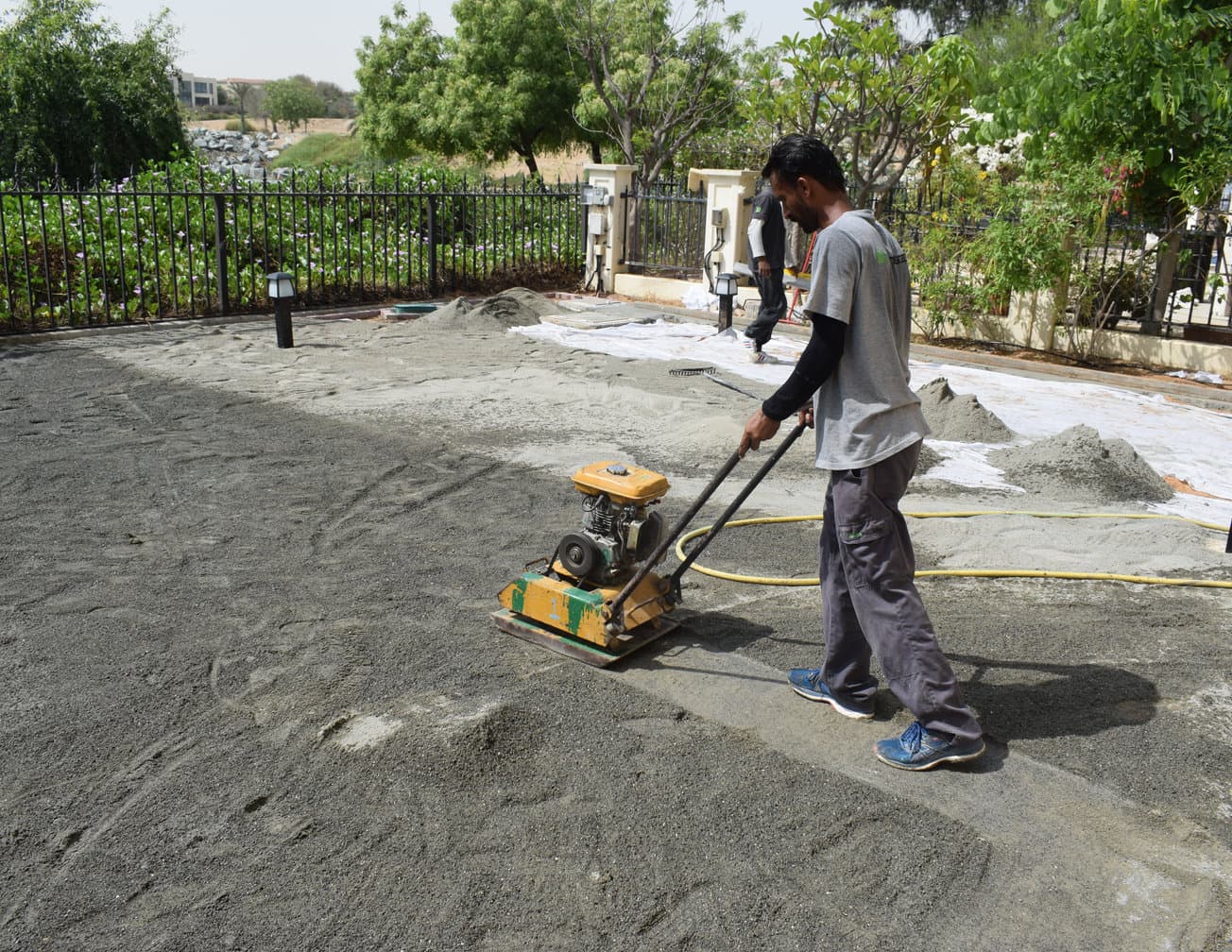
Where we are doing the installation, we check the ground preparation the day before we start. We are looking to see that the area has been levelled and compacted correctly and that the site is ready for the following day. It avoids any surprises and delays when our installation team arrives the next morning to begin.
What actually goes wrong on trade jobs
Three failures account for most of the remedial work we get called into, and all three are decided before the grass arrives.
The base was never properly compacted. The type of ground preparation depends on what's already there, not on budget. A concrete screed or a base another contractor has already built to specification needs a dry fit and nothing more. Ground that already carries an existing black sand base, or a base that needs relevelling and compacting, is a semi preparation. Natural grass, sand or large gravel underneath means full ground preparation — a black sand base of 7 to 10 cm, levelled and compacted, with the cement gluing edge. Semi preparation is not a cut corner and a contractor quoting it may be completely right. What causes ruts along the walking line is a base that's too thin, uneven, or never properly compacted, whichever type it was meant to be. Read how ground preparation is done here before you write the method statement.
The grass was pinned instead of glued. Grass held down only with nails or pins shrinks back a little with every change of season and never comes back. Within a year or two, gaps open where the grass meets tiles or paving, and they only widen. Nothing short of lifting and refitting closes them, and by then it's a defect against your name. Glued onto a cement gluing edge, the perimeter is held permanently and the seasonal movement has nowhere to go.
There was no silica sand infill installed, to cut costs. You won't see it on handover day, but you will see it later when the pile is lying flat and the surface is running hotter than it should. If a submission comes in well below everyone else's, the silica sand is the first line we'd check.
All three are avoidable, and the specification is where you avoid them.
Questions contractors ask us
Can you hold stock for a phased job? Talk to us at the order stage rather than partway through. Reserving the sqm for a phased job is straightforward when it's planned in, and we'll confirm what's held in writing.
Do you deliver to site, or do we collect? We deliver across the UAE from Dubai Industrial City, usually within one to two working days and two to three on a large order. Collection is fine too, but tell us the vehicle — full rolls are heavier and more awkward than people expect.
Do you provide quotations for a contractor's specific specification? Yes. Send us the specification itself rather than a summary of it. If something in it is unbuildable, or it names a grass type that no longer exists, it's much cheaper to find that out before the tender goes in.
Can our own client come and see the samples? Yes. We have samples and sample packs available at the showroom in Al Quoz, which your client can view and collect free of charge. We always recommend a client takes a sample pack away so they can see and feel the quality of our grass products, because photos really don't do it justice.