Artificial Turf Grass in Dubai: What the Words Mean
Artificial turf, artificial grass, synthetic turf, astro turf — all the same product. What actually differs, and what you'll be buying in the UAE.
By Maze Grass
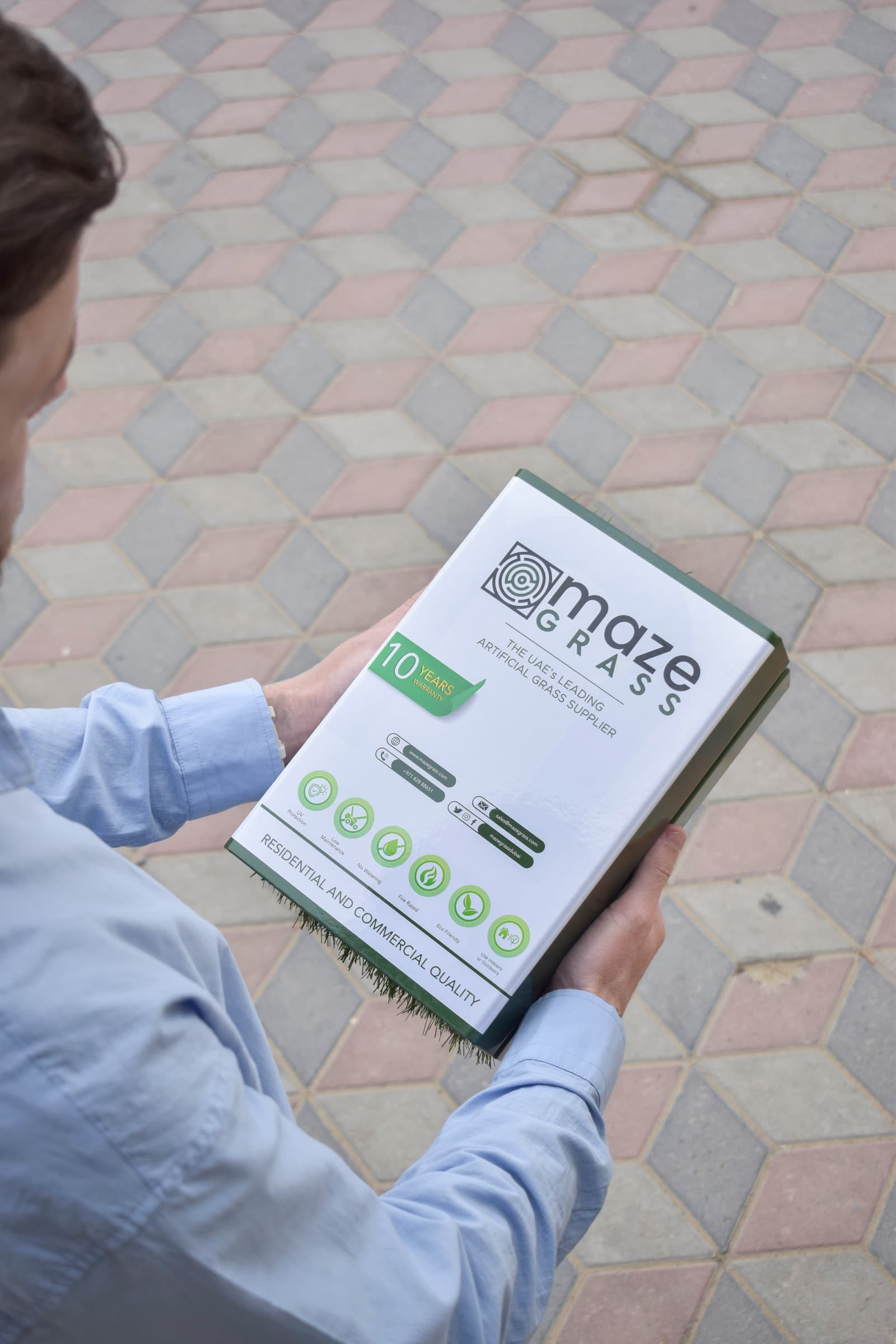
If you've been searching for artificial turf grass, or artificial grass, or synthetic turf, you've probably noticed that every supplier in Dubai uses a different word and none of them explain why. It makes the whole market look more complicated than it is, and it leaves you wondering whether artificial turf and artificial grass are two different things you're supposed to choose between. They aren't. There is one product here, and it goes by five or six names depending on who wrote the website.
Artificial grass, artificial turf, synthetic turf, fake grass and astro turf all describe the same thing, and no supplier in the UAE means anything different by them. So ignore the word a supplier uses and ask for the specification instead — grass density, pile height, backing and the silica sand infill rate. Those four decide whether your garden still looks right in year five, and none of them show up in the name of the product.
Is there any real difference between artificial turf and artificial grass?
No. They are two names for a surface made the same way: polyethylene fibres stitched into a backing fabric, sealed with a latex coat, and rolled out over a prepared base.
The words come from different places rather than different products. "Turf" is the older landscaping and sports word for a layer of growing grass with its soil, so "artificial turf" arrived through the sports industry. "Artificial grass" and "synthetic grass" came through the domestic and landscaping side. "Fake grass" is what people type into Google when they can't remember either. Searches in the UAE are split across all of them, which is why most suppliers hedge and use three at once.
Astro turf is the one that sounds like a separate category and isn't. AstroTurf is a trade name — a specific manufacturer's product, first laid in the Houston Astrodome in the 1960s, which became a generic word the same way Hoover and Biro did. When somebody in Dubai says astro turf, they usually mean either a sports surface or a short, hard-wearing grass. They almost never mean the branded product.
The words you'll see in the UAE, and what each one usually signals
None of these are technical terms, so treat them as a clue about who is writing rather than a description of what you'll receive.
| The word used | What it usually signals | What it tells you about the product |
|---|---|---|
| Artificial grass | A landscaping supplier writing for homeowners | Nothing |
| Artificial turf / synthetic turf | A supplier with a sports or trade background | Nothing |
| Synthetic grass | Usually a direct translation or an international brand | Nothing |
| Fake grass | Informal, and often a retail or online listing | Nothing |
| Astro turf | Sports pitches, or somebody using it loosely | Sometimes a short pile, sometimes nothing |
| Grass carpet | Thin, carpet-style rolls for temporary use | A genuinely different product |
Only the last row names something distinct. Grass carpet is the thin, short-pile roll sold for events, market stalls and short-term balcony cover, and it is a real category with real uses — we've gone through where it works and where it doesn't in our guide to artificial grass carpet. Everything else on that list is vocabulary.
What actually differs between one product and the next
Once you stop comparing names, there are four things on a specification that change what you get. Ask about these four and you can compare any two suppliers in the UAE, whatever either of them calls the product.
Grass density. This is the stitch rate per square metre, and it matters more than anything else on the list. A shorter grass with a high stitch rate has more grass per square metre than a longer grass with a low stitch rate. It stands up better under use and it gives more cushion underfoot. A well-stitched 33 mm will beat a sparse 42 mm, even though 42 sounds like more grass.
Pile height. The length of the fibre, in millimetres. It changes the look far more than the performance. A deeper pile looks lusher in a garden that isn't walked on much; a shorter, denser pile handles traffic and cleans more easily. Our Duramax 33 mm and Milan 35 mm sit either side of that decision, and most people settle it by feel rather than by number.
The backing. The yarn is stitched into a backing fabric and then locked in with a latex layer, cured in an oven. It's the part nobody looks at, and it's the part that decides whether the grass holds together in this climate. The backing needs UV stabilisation just as much as the fibres do, and plenty of products that advertise UV resistance only mean the yarn.
The silica sand infill rate. Sand brushed down into the pile after the grass is laid, at 4 to 5 kg per square metre. It does three separate jobs: it holds the fibres standing upright, it absorbs heat so the surface runs cooler underfoot, and it stops static building up. It's also real material and real labour, which makes it the easiest line to quietly leave out of a quotation. Ask for the rate in kilograms per square metre and have it written into the specification.
What none of the words tell you, and what to ask instead
The label tells you nothing about how long the grass will last, so the question has to be asked directly.
What shortens the life of artificial grass in the UAE is poor UV stabilisation. The fibres go brittle after a year or two, they start to disintegrate under foot, the grass begins to look short, and eventually the backing shows through. That's a different failure from a garden that goes rutted and uneven, which comes from a base that was never properly compacted. The two get confused constantly, and the fix for one is nothing like the fix for the other.
So ask for the third-party test certificates, and ask whether they cover the backing as well as the fibres. We import all our grass from Europe, where chemical regulation in manufacturing is strict and enforced, and every range is independently tested by SGS for chemical breakdown, heavy metals, UV stability and fire rating. We send those certificates to anybody who asks. Every grass we sell carries a minimum 10-year manufacturer's warranty with no exceptions, and Maze Grass has been trading here for almost 14 years, which matters more than the warranty document does — a ten-year cover is worth whatever the company behind it is still worth in year eight.
The ground under it matters as much as the grass on top
Buying the grass is one part of the job. Preparing the ground underneath it is the other, and the two are equally important. A specification sheet can be perfect and the garden can still go wrong, so it's worth knowing what happens under the grass before you agree to anything.
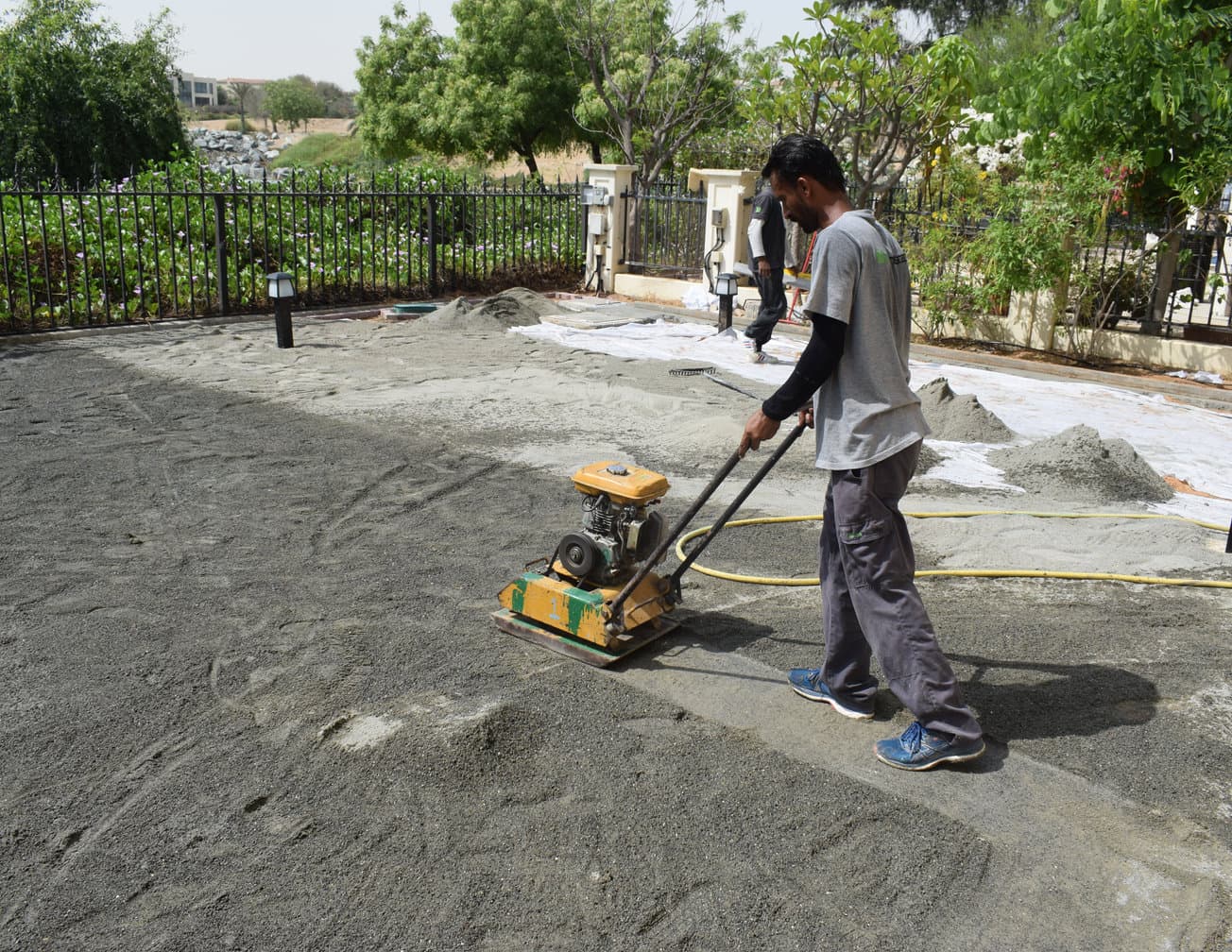
In the UAE the build runs in a fixed order. A black sand base of 7 to 10 cm, levelled and compacted, where the ground is being built up from scratch. A cement gluing edge installed around the perimeter. The grass laid, trimmed, joined and glued to that edge. Then silica sand infill at 4 to 5 kg per square metre, brushed up through the pile.
The gluing is worth pausing on, because it's the thing you'll notice in year two. Grass fixed only with nails or pins shrinks back a little with every change of season and never comes back, so gaps open along the edges where the grass meets your tiles or paving, and they only widen. Glued to a cement gluing edge, the perimeter is held permanently. Ask any supplier whether the grass is glued or nailed, in those words, and treat any answer other than glued as a problem. Our guide to ground preparation covers the three types and which one your garden needs.
How to compare two suppliers when they use different words
Take the vocabulary out of it and the comparison gets a lot shorter. Whatever each of them calls the product, ask all of them the same five things.
- What is the grass density, as a stitch rate per square metre, and what is the pile height in millimetres?
- Is the backing UV stabilised, and do the test certificates cover the backing as well as the fibres?
- What silica infill rate is allowed for, in kilograms per square metre?
- Is the grass glued to a cement gluing edge, or fixed with nails and pins?
- What does the warranty actually cover, and how long has the company been trading here?
Then get a physical sample in your hands before you decide anything. Photos really don't do it justice — colour, density and how the fibres feel are the three things a screen cannot show you, and they're the three things you'll live with. Sample packs are free to view and collect at our showroom in Al Quoz, and we'd always recommend taking one away and looking at it in your own garden, in your own light.
FAQs
Is artificial turf the same as artificial grass?
Yes. Same product, different word. The only thing on the market that is genuinely a separate category is thin grass carpet, which is made for events and temporary cover rather than for a garden. If a supplier's quotation uses one word in the heading and another in the body, that's normal and it isn't a warning sign.
Which term should I search for in Dubai?
It makes very little difference now, because suppliers here write for all of them anyway. What does change your results is adding what you actually need: the area, the use, or the emirate. Searching for artificial turf in Dubai, or artificial grass for a balcony, will get you further than the generic term on its own.
Does artificial turf work in UAE heat?
It works, and it does get hot. From June through August it is too hot to walk on barefoot in the middle of the day, and so is your stone, your tile and your decking. Shade changes it completely, a hose drops the surface temperature in seconds, and the silica infill helps. We've answered this one properly in our post on whether artificial grass gets hot in Dubai.
How long does it last here?
At least 10 years, which is why every grass we supply carries a minimum 10-year manufacturer's warranty. The products that fail early in this climate fail because the fibres were never properly UV stabilised, not because of the heat itself.
Can I buy the grass and have my own contractor lay it?
Yes. We supply grass on its own as well as installing it, and plenty of landscapers and contractors buy from us that way. Our stock is held in Dubai Industrial City, and we install in both Dubai and Abu Dhabi, which is less common here than you'd expect.
If you want a straight answer about your own garden rather than a definition, get in touch and we'll come out, measure up and bring the samples with us.