Vertical Gardens in Dubai: Artificial Green Wall Guide
How vertical gardens work in Dubai's climate, why living walls are harder work than they look, and what an artificial green wall really involves.
By Maze Grass
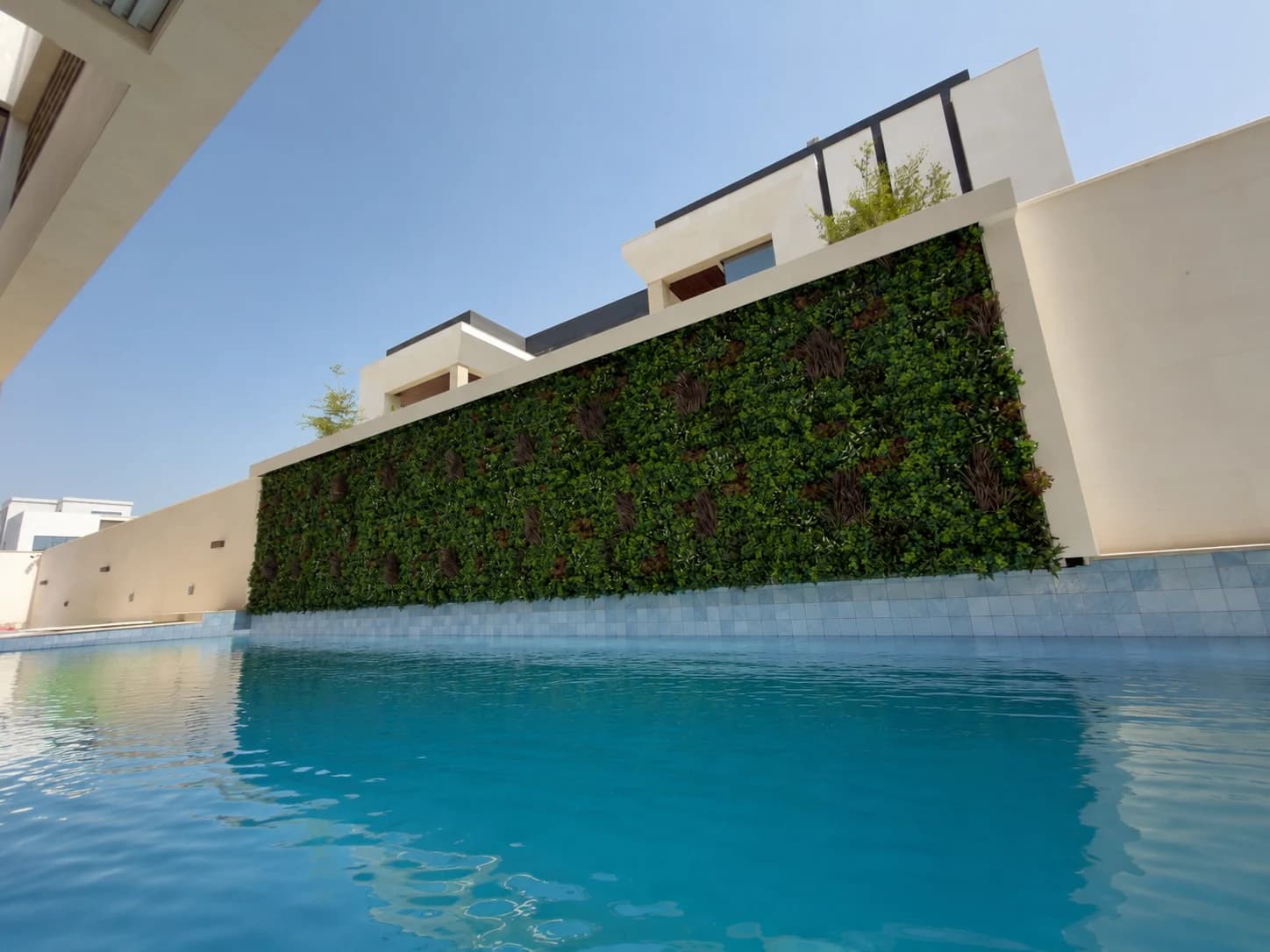
If you have been looking into a vertical garden in Dubai, you will have found two quite different things sold under the same name. One is a living wall: real plants rooted in a growing medium, fed by an irrigation line and a fertiliser dose. The other is an artificial green wall, built from moulded foliage panels fixed to a wall, a ceiling or a frame. In a photograph they can look almost identical. They are very different to live with, and the climate here widens that gap rather than closing it.
Both work in Dubai, but they ask different things of you. A living wall needs irrigation, feeding and someone who knows plants looking after it. An artificial green wall needs no water and very little attention, and a properly UV stabilised panel holds its colour in direct sun. If nobody is going to maintain it every week, the artificial one is the sensible choice.
Two ways to build a vertical garden in Dubai
A living wall is a planting system turned on its side. Plants sit in pockets, modular trays or a felt medium, held against a backing board with a drip line running across the top and a drain or tray at the bottom. It is a real garden, and it behaves like one.
An artificial green wall is a cladding system. Panels of moulded foliage — usually a mix of leaf shapes and green tones so the surface does not read as one repeated pattern — are fixed to whatever is behind them and trimmed to fit the opening. Once it is up, it stays as it is.
| Living wall | Artificial green wall | |
|---|---|---|
| Water | Irrigation line, timer and a water source | None |
| Ongoing care | Feeding, pruning, replacing plants that fail | Occasional dusting or a rinse |
| Light | Species chosen to suit the light the wall actually gets | Irrelevant — it goes anywhere |
| Full outdoor summer sun | Limits the plant list and raises water demand | No effect on a UV stabilised panel |
| Basements, lift lobbies, windowless rooms | Needs grow lighting | Works as it is |
| Ceilings and soffits | Not practical | Straightforward |
Why living walls are harder work here than people expect
Nothing about a living wall is impossible in the UAE. There are good ones in Dubai, and they tend to share the same two features: a designed irrigation system and a maintenance contract with somebody who knows plants.
The climate makes both of those non-negotiable. Summer highs sit in the mid-forties for months, a pattern the National Center of Meteorology records every year, and a vertical planting bed is a shallow one. Water passes through it far faster than it would through open ground, so an outdoor living wall in July is watering more often than a garden, not less. If the timer fails on a Thursday, you can lose a section of the wall before anyone notices on Sunday.
Light is the indoor version of the same problem. The Royal Horticultural Society's guidance on houseplants comes back to the same fundamentals every time — the right light level, the right watering, the right feeding. A reception wall two floors away from a window is not giving plants much to work with, which is why indoor living walls usually arrive with grow lighting attached and a bill to run it.
Then there is the wall itself. Anything holding a damp growing medium against a building needs a waterproof backing and a drainage route, and that is a detail worth getting right rather than discovering later.
None of this is an argument against living walls. It is the honest scope of what you are taking on, and it is why a lot of green walls in Dubai are artificial.
Indoor and outdoor, and what UV stabilisation actually means
Indoors, almost any panel will look fine for years. There is nothing to test it.
Outdoors is where the difference between products shows. Ultraviolet light breaks down the polymers in a plastic leaf, and an unstabilised panel on a south-facing wall goes the same way cheap artificial grass does: the colour drains out of it, the material turns brittle, and the edges start to crumble when you touch them. It does not take a decade. It can happen in a couple of seasons.
UV stabilisers are additives mixed into the material during manufacture to slow that reaction down. Our green wall panels are fully UV stabilised, which is the specification that matters if the wall is in sun for any part of the day. Ask the question directly, and ask for it in writing, because every supplier will tell you their product is suitable for outdoor use and the word "outdoor" on its own means nothing.
One more outdoor consideration: fine sand settles into foliage the same way it settles into a garden. It is a cleaning job rather than a durability one, but it is worth knowing before you put a green wall somewhere you cannot reach.
Where a green wall earns its place
At home, the spaces that come up most are the ones where a real planting bed was never going to happen:
- Balconies and terraces, where the wall is concrete or blockwork and there is no soil anywhere.
- Courtyards and side returns — a narrow, shaded strip that gets no direct light and grows nothing.
- Boundary and party walls, used to soften a tall run of render or to screen a neighbour's view.
- Majlis and seating backdrops, and the wall behind an outdoor kitchen or a pool.
- Plant rooms and AC units, where the panel is doing a screening job as much as a decorative one.
Commercially, the same product is doing something slightly different. Interior and exterior designers across the UAE specify green walls for reception areas, restaurant and café interiors, hotel lobbies, retail units and event spaces, largely because it delivers greenery to a space with a fit-out programme and no intention of employing a gardener. Ceilings and soffits are worth mentioning separately: overhead foliage in a restaurant or under a pergola is simple with panels and impractical with living plants.
Artificial grass gets used vertically too, on signage and feature panels, which is a different look again — we wrote about artificial grass used on walls and billboards after one of those projects.
What the installation involves
The panels are not fixed to the wall directly. A wooden frame is built and screwed into the wall, floor or ceiling, and the panels are fixed to that frame and cut around openings, corners and any fittings that stay in place. It is the same method on a boundary wall, an interior partition and a ceiling, and it is how a freestanding screen or a divider between two spaces gets built as well.
That method sets one real condition on the job: whatever is behind the panels has to be solid enough to take a screw and hold it. It is the first thing the in-house installation team at Maze Grass checks, and it is why the wall gets measured on site rather than assessed from a photograph.
A few things then change the scope of the job:
- The area, and its shape. A long low run and a tall narrow one of the same square metreage are not the same amount of work.
- The fixing surface, and how the frame has to be built into it.
- Access and height. Anything above reach needs equipment and takes longer.
- Indoor or outdoor, which sets the specification rather than the labour.
- Openings and obstructions — lights, sockets, downpipes, signage, anything that has to be cut around neatly.
Most green walls go up quickly once the frame is in. We will bring a panel with us so you can see and handle the foliage before you commit to it.
How to judge one panel against another
Held at arm's length, every green wall panel looks convincing. These are the things worth checking when you have one in your hands:
Is it UV stabilised, and does the supplier say so in writing? For anything outdoors, this is the whole question.
How varied is the foliage? A good panel mixes leaf shapes and several tones of green. A cheap one repeats a single moulded leaf in a single colour, and the repetition becomes obvious as soon as you cover a large wall with it.
Can you see the backing? Press the foliage down and look at it from an angle. Thin panels show their grid through the leaves, and a wall lit from the side will show it more than the showroom did.
What does it look like in daylight? Indoor lighting flatters foliage. Take the sample outside.
What documentation comes with it? On a commercial interior in particular, ask what the supplier can provide, because the fit-out contractor will be asked for it whether you were expecting the question or not.
Living with one
An artificial green wall needs no watering, and that is the point of it. What it does need is occasional attention to dust.
Indoors, that is a feather duster or a vacuum on a low setting every few months, more often near a busy door. Outdoors, a rinse with a hose clears settled sand and dust, and a wall under a tree will want doing more often than one on an open terrace. Neither job takes long, and neither needs anyone with horticultural knowledge — which, over five years, is a meaningful difference from a wall of real plants.
FAQs
How long does an artificial green wall last outdoors in Dubai?
Our green wall panels are fully UV stabilised and carry a five-year warranty. That is a separate term from the minimum 10-year manufacturer's warranty on our artificial grass. They are two different products, made differently and covered separately, so a supplier quoting one warranty across both is worth a second question. What ends a green wall early is almost always poor UV stabilisation: the colour goes, the material turns brittle, and the panels start breaking up at the edges.
Can an artificial green wall be installed on glass?
No. The wooden frame has to be screwed into the surface behind the panels, and there is nothing in a sheet of glass to screw into. That rules out glass balustrades on balconies and terraces, glass office partitions and shopfront glazing, so it is worth knowing before you design a space around one. Where the glazing is set into a solid surround, the frame sometimes has somewhere to go even though the glass itself does not — that is a question for the site visit. If you rent, ask your building or your landlord what you are allowed to fix into at the same time, because balconies and party walls often have rules of their own.
Do artificial green walls attract insects or go mouldy?
There is no soil, no growing medium and no standing water in an artificial panel, so there is nothing in it for insects to live in or feed on, and nothing staying damp behind it. A living wall carries all three by design, which is part of why it needs a waterproof backing and a drainage route. Dust is the only thing that accumulates on a green wall, and it rinses or brushes off.
What is the quickest way to find out what my space needs?
Book a free site visit. The fixing surface, the access and the light decide how the wall gets built, and none of them can be judged from a photograph. You can see the full panel range on the Mazewall green wall panels page, or get in touch and we will come out, measure up and bring a sample with us.